
What Type of Grass Do I Have? How to Identify Your Canberra Lawn
G'day, Nikolai here from The Lawn Firm. Nearly every free assessment I do starts with the same question from the homeowner, and it is usually asked with a bit of an apology attached: "I have no idea what grass this actually is." You do not need to apologise. Most people inherit a lawn when they buy a house, nobody hands over a certificate with it, and after a few years of patching and reseeding a lot of Canberra lawns are honestly a mix of two or three things.
But it matters. The grass type decides when you fertilise, how low you can cut, which herbicides are safe, whether overseeding will work, and how the lawn will behave through a Canberra winter. Get the identification wrong and you can spend a whole season doing sensible things at completely the wrong time.
So here is how I work it out on site, and how you can do a decent job of it yourself before I even arrive.
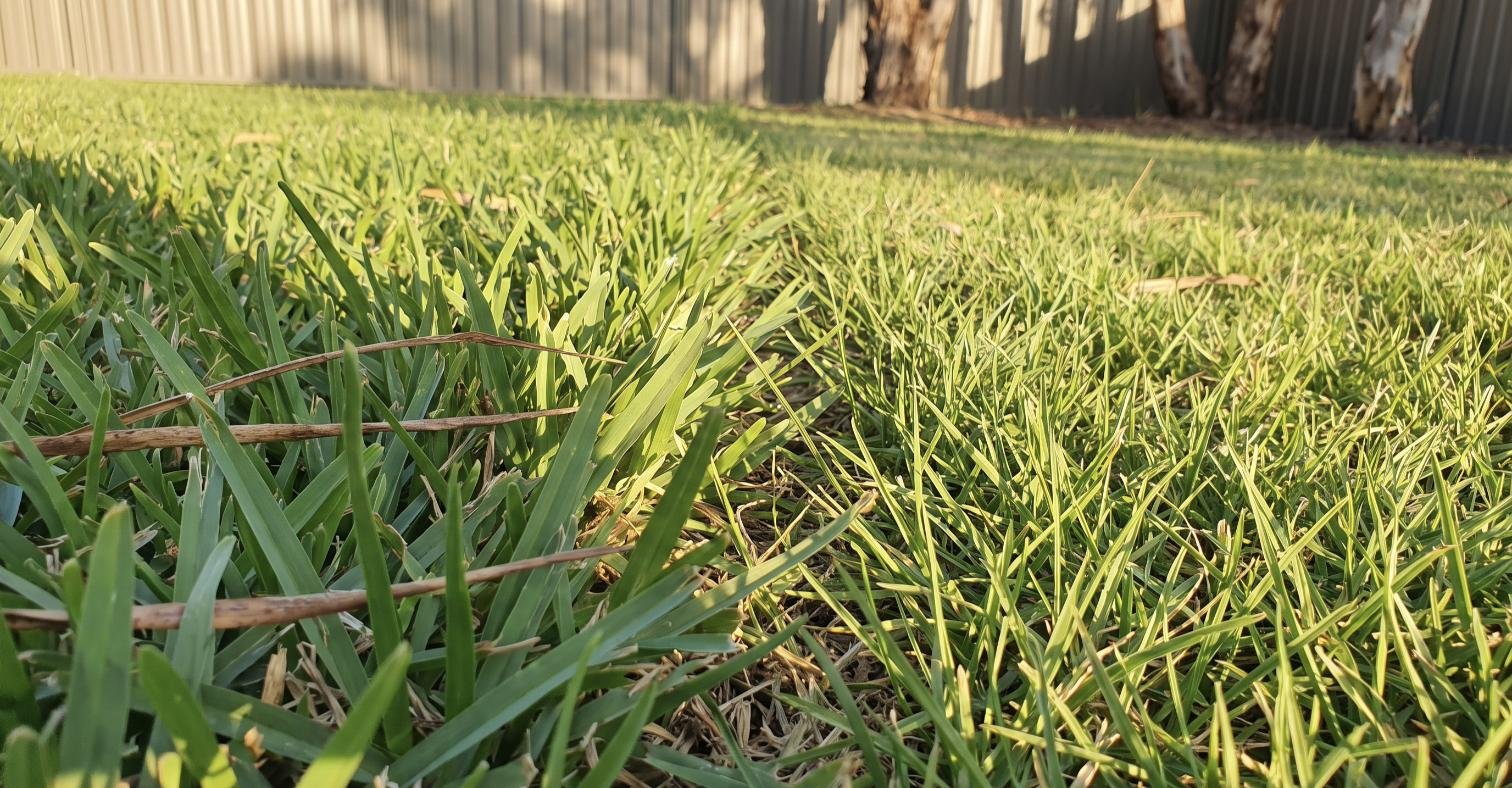
Broad soft leaf buffalo meeting fine bladed couch in a Canberra backyard, the leaf width and runners that identify each variety clearly visible
The quick answer: how to identify your grass type
Look at three things, in this order.
Does it spread by runners, or grow in clumps? If you can pull back the turf and see horizontal stems creeping sideways above or below the soil, you have a running grass: buffalo, kikuyu, couch or zoysia. If it grows in tufts from a single crown with no runners, you have a clumping grass, which in Canberra almost always means tall fescue.
How wide is the leaf? Buffalo is broad and soft, roughly 8 to 12mm. Kikuyu is broad and coarse. Tall fescue is medium and slightly glossy. Couch is fine, around 2 to 4mm. Zoysia is fine to medium with a stiff, wiry feel.
What does it do in winter? In Canberra, warm season grasses (buffalo, kikuyu, couch, zoysia) go dormant and lose colour from roughly May to September. Cool season grasses (tall fescue) stay green through the frost. If your lawn browns off every winter and greens up in spring, it is warm season. If it stays green in July, it is fescue.
Those three checks will place almost every Canberra lawn correctly. The rest of this article is the detail that lets you separate the ones that look similar.
Why the answer actually changes what you do
This is not trivia. Here is what hangs off it.
Fertiliser timing. Warm season grasses want their main feeds through the growing season from spring into early autumn. Feed them heavily in the middle of a Canberra winter and you are mostly feeding weeds. Tall fescue is the opposite and does its best growing in the cooler shoulder seasons. I go through the full timing logic in my complete guide to lawn fertilisation in Canberra.
Herbicide safety. This is the big one. Buffalo is sensitive to several common broadleaf actives that couch and kikuyu shrug off. Spray a buffalo lawn with the wrong product and you can thin it out badly or lose it in patches. If you are not certain what you have, do not spray. That is genuinely the whole advice.
Cutting height. Buffalo wants to be kept relatively high so it can hold its stolons and shade the soil. Couch and zoysia tolerate being cut much lower. Scalp a buffalo lawn down to couch height and you will expose runners and open the door to weeds.
Whether overseeding will work at all. Oversow tall fescue into a fescue lawn and it knits in. Throwing cool season seed into a dense couch or kikuyu lawn is mostly wasted money, because the runners out compete the seedlings. That is why I identify the grass before recommending seeding or overseeding.
What "normal" looks like. A couch lawn going straw coloured in June is not sick. A fescue lawn going straw coloured in June is a problem. Same symptom, opposite meaning.
That is the difference between guessing and diagnosing. If you would rather not guess, Book a Free Assessment and I will tell you exactly what is in the ground.
Step one: runner or clump
Get down on your knees at the edge of a garden bed or path, where the lawn is trying to creep out.
Take a section of turf and gently lift or pull it back. You are looking for stems that run sideways rather than up.
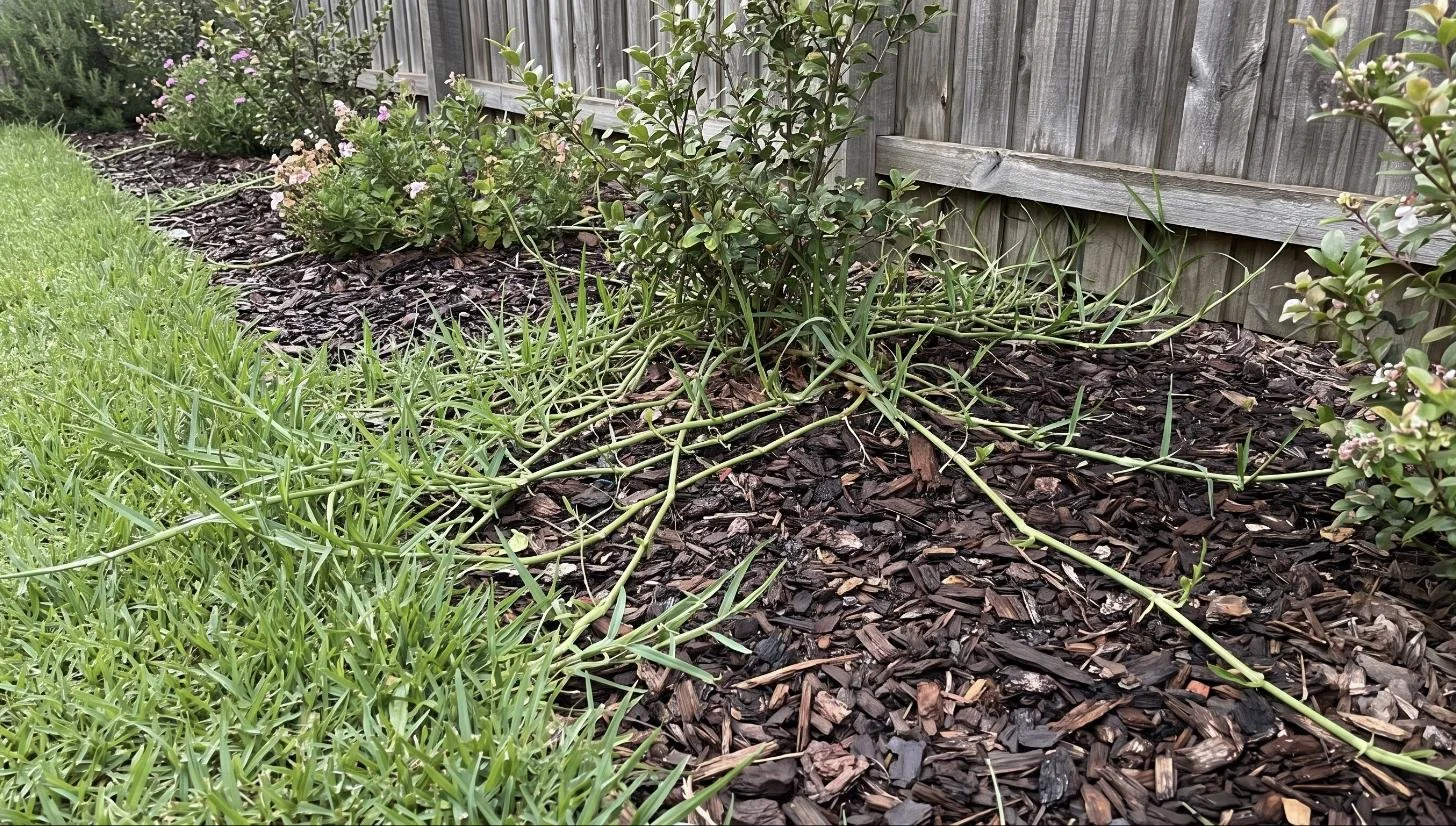
Stolons are runners that travel across the top of the soil, visible if you part the leaf. Buffalo and kikuyu are strong stoloniferous growers.
Rhizomes are runners that travel underground. Couch has both stolons and rhizomes, which is exactly why it is so hard to keep out of garden beds.
Clumping grasses have neither. Tall fescue plants sit as individual tufts. When a fescue lawn thins out, it thins into bare gaps, because nothing spreads sideways to fill them.
A quick field test: if your lawn is invading the driveway crack or the veggie patch, it is a runner grass. If your lawn goes patchy and just stays patchy until you sow seed, it is a clumper.
Step two: the leaf itself
Pull a single leaf blade and have a proper look at it.
Buffalo (Stenotaphrum secundatum). Broad, soft, folded in the shoot, blunt or boat shaped at the tip. Feels pleasant underfoot. Sheath is noticeably flattened. Modern soft leaf varieties dominate newer Canberra estates.
Kikuyu (Pennisetum clandestinum). Broad but coarser and more upright than buffalo, with a hairy leaf sheath and very aggressive thick runners. Grows fast, recovers from damage fast, and will happily take over a garden bed in a season.
Couch (Cynodon dactylon). Fine, pointed, grey green to mid green, with fine wiry runners. Produces a very dense, fine textured surface when it is happy. Common on older Canberra lawns and sportsfields.
Tall fescue (Festuca arundinacea). Medium width, distinctly ribbed on the upper surface, glossy on the underside, and slightly rough along the edge if you run it between your fingers. Deep rooted, which is why it survives Canberra summers better than most cool season options.
Zoysia (Zoysia japonica and relatives). Fine to medium, stiff and slightly waxy, often described as feeling springy or dense. Slower growing than couch or kikuyu, and very dense once established.
If you want the full care regime once you have named it, I have written a dedicated guide for each of the five: buffalo, kikuyu, couch, tall fescue and zoysia.
Step three: what it does through a Canberra winter
Canberra gives you a free diagnostic every year, and most people ignore it. Our frosts are heavy enough and our winter soil temperatures low enough that warm season grasses shut down properly. From about May the colour drains out, growth stops, and the lawn sits dormant until soil temperatures climb again in September or October.
Goes brown or straw coloured every winter, greens up in spring: buffalo, kikuyu, couch or zoysia.
Stays green through July, keeps growing slowly, needs the odd cut in winter: tall fescue.
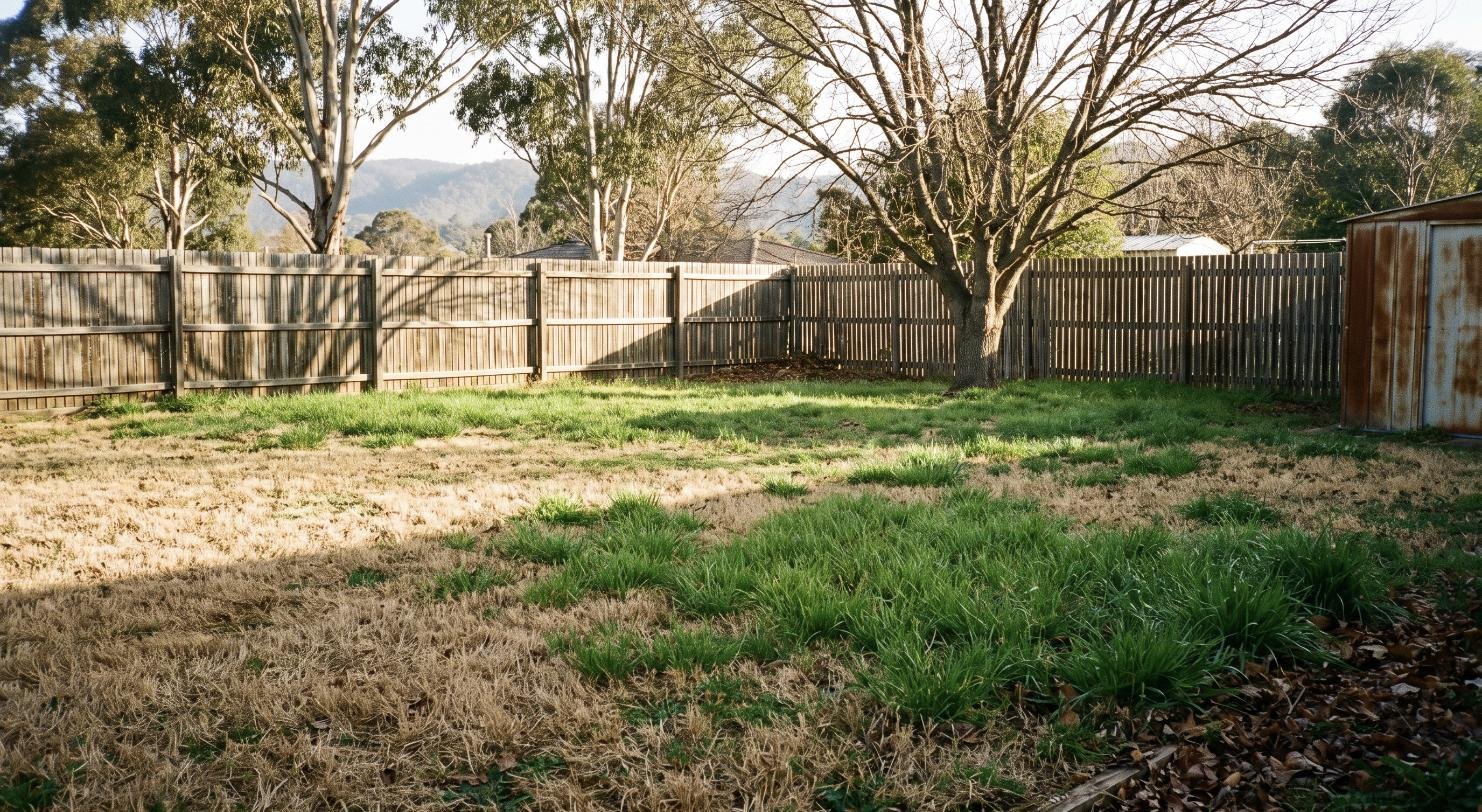
Green patches inside a brown lawn in July: you almost certainly have a mixed lawn, with fescue or winter grass surviving inside a dormant warm season base.
That last one catches a lot of people out. Bright green tufts in a dormant winter lawn are frequently not a bonus, they are winter grass, which is a weed and needs a different plan entirely.
Step four: how quickly it recovers from damage
Recovery speed is a useful tiebreaker when the leaf test is ambiguous.
Kikuyu recovers fastest of anything we grow here, closing a damaged patch within weeks in the growing season.
Couch recovers quickly too, though it needs sun and sulks badly in shade.
Buffalo recovers moderately and hates being scalped, because it repairs from surface runners you can easily cut off.
Zoysia is tough once established but slow to fill a bare patch.
Tall fescue does not spread sideways at all. It only fills a gap if you put seed there.
If a shaded section is thin and struggling, the grass type is usually the real cause rather than anything you did wrong, and I cover that in my guide to shaded Canberra lawns.
Common Canberra mix ups
Couch mistaken for zoysia. Both are fine leafed and dense. Zoysia feels stiffer and springier, grows noticeably more slowly, and holds colour a little later into autumn. Couch spreads far more aggressively.
Kikuyu mistaken for buffalo. Both are broad leafed runners. Kikuyu leaves are coarser and more upright, the runners are thicker and more obvious, and the growth rate is much faster. Buffalo feels soft when you walk on it barefoot. Kikuyu does not.
Tall fescue mistaken for a weed grass. In a dormant warm season lawn in winter, a healthy fescue clump can look like an invader. Check for the ribbed upper leaf surface and the tufted, non spreading growth habit.
A "buffalo lawn" that is really a buffalo and kikuyu mix. Extremely common in older Canberra suburbs. This matters enormously for herbicide choice, because the safe product for the kikuyu portion may not be safe for the buffalo portion. When I find a mixed lawn I keep the treatment plan conservative and deal with weeds selectively rather than blanket spraying.
Everything looks patchy so it must be the grass type. Sometimes the grass is fine and the soil is the problem. If water beads and runs off rather than soaking in, you may be dealing with hydrophobic soil rather than a variety issue, and a soil test settles that argument quickly.
My on site identification process
When I do an assessment, this is the order I work through.
Walk the whole lawn and note where it thrives and where it struggles, in sun and in shade.
Lift turf at two or three points and check for stolons, rhizomes or clumps.
Take leaf samples from each distinct looking area, because mixed lawns are the norm here.
Check thatch depth and the soil profile, since heavy thatch or compaction changes the plan regardless of variety. That tells me whether aeration and coring or thatch removal needs to come first.
Identify the weeds present, because weed species tell you a lot about soil and cutting history. My common Canberra lawn weeds guide is a good starting reference.
Only then do I build a treatment plan, because every step of it depends on the answers above.
It takes about twenty minutes and it prevents months of wasted effort. Book a Free Assessment and I will do exactly that walk with you.
Final word
Identifying your grass is the cheapest and highest value thing you can do for your lawn, because everything else depends on it. Runner or clump, leaf width, winter behaviour. Three checks, ten minutes, and every other decision gets easier.
If you part the turf and still are not sure, that is normal. Canberra lawns are messy mixtures more often than not. Book a Free Assessment and I will sort it out properly.
Key points I get asked on a regular basis
Can I identify my grass from a photo?
Sometimes, but not reliably. A photo taken from standing height flattens out the two features that matter most, which are leaf width and growth habit. If you want to try, get the camera right down at leaf level, include a coin or a fingertip for scale, and take a second shot showing a runner pulled clear of the turf. Even then, mixed lawns need someone on the ground.
What is the most common grass in Canberra lawns?
There is no single answer. Older established suburbs lean heavily towards couch and kikuyu, often mixed. Newer estates tend to be laid with soft leaf buffalo. Tall fescue turns up wherever someone wanted a lawn that stays green through winter, and it is common on shaded or south facing blocks. Zoysia is a smaller share but growing.
My lawn has more than one grass in it. Is that a problem?
It is not a disaster, but it does constrain your options. A mixed lawn will never look perfectly uniform, because the different varieties go dormant at different times and grow at different rates. The bigger issue is chemical safety: you have to treat the whole lawn as though it were the most sensitive variety present. In practice that usually means buffalo, and it means being much more careful with broadleaf products.
Does the grass type change what I can do about weeds?
Yes, significantly. Some selective herbicides that are safe on couch and kikuyu will damage buffalo, and a few will damage zoysia. This is why I never give a spray recommendation over the phone without knowing the variety. If you are dealing with a specific weed, my guides to common lawn weeds and bindii will tell you what you are looking at, and the treatment side is best confirmed at an assessment.
Can I change my lawn to a different grass type?
You can, but it is a renovation job rather than a maintenance job. Converting a warm season lawn to fescue, or the other way around, means removing or exhausting the existing grass first, because runners keep pushing back through for years otherwise. It is doable and I do it, but it needs planning around the right season rather than a bag of seed in the boot.
How do I book a lawn assessment in Canberra?
The easiest way is to Book a Free Assessment through the form on my homepage. I will come out, identify what you actually have growing, check the soil and thatch at the same time, and give you a plan that suits your grass rather than a generic one. No obligation, and you will at least walk away knowing the name of the thing in your backyard.
Looking for the perfect gift for the lawn enthusiast in your life? The Lawn Firm Gift Cards are the ideal solution. Redeemable for any of our professional lawn care services, these gift cards make it easy to give the gift of a greener, healthier lawn. From fertilisation to weed control and pest management, there’s something for every lawn need.
Why Choose a Lawn Firm Gift Card?
Versatility: Can be used for any service offered by The Lawn Firm.
Thoughtful Giving: A practical gift for anyone who values a beautiful outdoor space.
Simple to Use: Purchase online and enjoy easy redemption.
Order your gift card today and let your loved ones experience the professional touch of The Lawn Firm. It’s the perfect way to show you care while helping someone achieve the lawn of their dreams.
This gift card never expires.