
Mushrooms and Toadstools in Canberra Lawns: What They Mean and What to Do
G'day, Nikolai here from The Lawn Firm.
You walk out on a still, damp Canberra morning and there they are. A scatter of little pale caps through the grass, or a ring of them out on the back lawn, or one fat brown thing the size of a bread roll that definitely was not there yesterday. The phone call I get next is almost always the same: what disease is this and what do I spray on it.
Here is the part that surprises most people. Mushrooms in a lawn are not a disease of the grass, and there is no product you can buy that will get rid of them properly. What they are is a signal, and once you can read the signal you will know whether to do nothing at all or whether something underneath needs attention.
If you have mushrooms coming up and you want to know what is going on under your lawn, Book a Free Assessment and I will come and take a look.
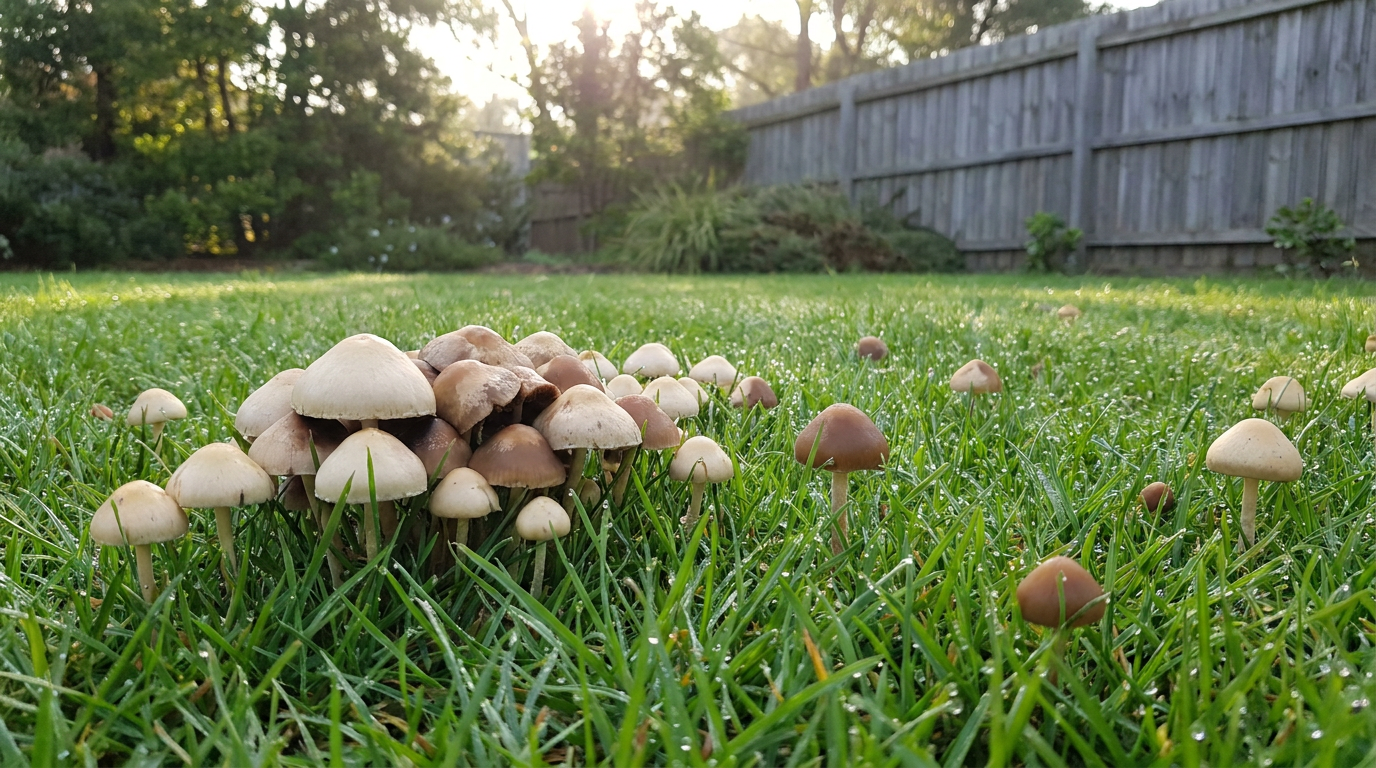
A damp patch of Canberra lawn where decomposing organic matter below the surface feeds fungal activity
The quick answer: what lawn mushrooms actually are
A mushroom is the fruiting body of a fungus. The fungus itself is a fine white thread network called mycelium living in the soil and thatch, and it has usually been there for months or years. The mushroom is just the bit that pops up above ground to release spores when conditions suit, in the same way a fruit tree is there all year but only fruits for a few weeks.
Those fungi are almost always decomposers. They are feeding on dead organic matter in the soil: old tree roots, buried timber, thatch, leaf litter, or the remains of turf laid over something that was never cleared. They are not attacking your living grass.
That means three things follow.
Mushrooms appearing is normal and, in most cases, a sign of biologically active soil rather than a sick lawn.
There is no fungicide that meaningfully removes them, because killing a mushroom does nothing to the mycelium underneath, and treating the mycelium would mean sterilising the soil.
They will disappear on their own within a few days once the weather dries or warms up, and they will come back next time conditions repeat.
The right response is almost always to remove them for safety and tidiness, then work out what buried organic matter or moisture pattern is feeding them.
Why they turn up in Canberra when they do
Fungi need three things at once: moisture, moderate temperature, and something dead to eat. Canberra hands them all three in fairly predictable windows.
Autumn and late winter into early spring. Mild days, cold nights and reliable moisture. This is the main flush.
Any run of wet, overcast, humid days. A week of drizzle in November will do the same job as autumn.
Where irrigation overlaps. If two sprinklers double up on one section, that section stays wetter for longer and fruits first. Worth checking, because it is an easy fix.
Shade. Under trees, along a south facing fence line, beside the shed. Anywhere that holds dew until mid morning. My guide to lawn care for shady Canberra lawns covers the wider set of problems that shade creates.
Over buried wood. This is the big one in Canberra, particularly in newer estates and in older blocks where trees have come out. Stumps ground down but left in the ground, root systems from a removed eucalypt, offcuts of formwork timber buried by a builder, even old fence posts. The fungus works through that timber for years and fruits above it.
In thick thatch. A heavy thatch layer is a food source and a moisture reservoir in one. If you have both mushrooms and a spongy underfoot feel, thatch is worth measuring. I set out how in my guide to lawn thatch in Canberra lawns.
Reading the pattern: what shape tells you
The way mushrooms are arranged tells you a lot before you dig anything up.
Scattered singles across the whole lawn. Ordinary decomposition of thatch and root litter. Almost always harmless and temporary. Do nothing beyond removing them.
A tight cluster in one spot, year after year. Something is buried there. Usually a stump, a large root, or builder's timber. The cluster will keep returning until that material has fully broken down, which can take several years.
A circle or arc of mushrooms, often with a ring of darker green grass. This is a fairy ring, and it is the one case where the fungus can actually affect your turf. More on it below.
A line along one edge or under one tree. Follow the moisture. That is usually an irrigation overlap, a downpipe outlet, or a shaded strip that never dries.
Mushrooms plus yellowing, thinning turf in the same spot. Now I want a closer look, because the fungus is probably not the cause. Grub damage, a fungal turf disease or dry patch can all sit alongside mushrooms coincidentally. Spongy turf that lifts like a rug points at lawn grubs, beetles and armyworms, and defined circular patches with discoloured margins point at a genuine turf disease, which I cover in my lawn fungus and disease guide.
Fairy rings, and why they are the exception
A fairy ring is a colony of fungus growing outwards from a central point in an expanding circle. You will see one of three things, sometimes all three: a ring of mushrooms, a ring of unusually dark green fast growing grass, or a ring of dead or struggling grass.
The dark green ring happens because the fungus is breaking down organic matter and releasing nitrogen as it goes, so the grass above it gets a free feed. The dead ring happens because the mycelium can become so dense that it makes the soil beneath water repellent, and the grass above it simply cannot get a drink.
That second version is the one worth acting on. The practical approach is to break the water repellency rather than try to kill the fungus:
Core or aerate aggressively through the affected ring so water has a direct path down. My method is in the guide to lawn aeration and coring in Canberra.
Apply a wetting agent to the ring and water it in hard, then keep the ring wetter than the rest of the lawn for a few weeks. I go through choosing and applying one in lawn wetting agents in Canberra.
Feed the whole lawn evenly so the dark green ring stops standing out against everything around it.
Repair the bare ground once the soil is taking water again, by overseeding or plugging. My approach is in lawn seeding and overseeding in Canberra.
Fairy rings are stubborn and they can persist for years. Managing them so they are not visible is realistic. Eradicating them from a home lawn without excavating the soil is not, and I would rather tell you that up front than sell you a treatment plan that cannot deliver.
What I actually do about mushrooms
For the ordinary, harmless kind, this is the whole job.
Knock them off or pick them. Do it as soon as you see them, ideally before the caps open and release spores. A stiff rake or the side of your boot is enough.
Bag them, do not compost them and do not mulch them into the lawn. Mowing over them spreads spores across the whole lawn and gives you more of them next week.
Wash your hands afterwards, and keep an eye on where the bag goes if you have a dog that raids bins.
Check your watering. Shift to deep, infrequent morning watering so the surface has all day to dry. Evening watering keeps the thatch damp overnight, which is exactly what the fungus wants.
Reduce the food source where you can. Rake out leaf litter, deal with excess thatch by scarifying or coring, and if a cluster keeps returning in one spot, dig down and see what is under it. Removing a buried lump of timber solves that spot permanently.
Improve airflow and light in the damp corners. Lifting the canopy on a low tree or thinning a shrub often does more than any product.
Keep the lawn healthy and dense. A thick, well fed sward is not immune to mushrooms, but it recovers faster and hides them better. That is what a year round programme is for, and mine is set out in my Canberra lawn maintenance programme.
What I do not do is reach for a fungicide. Turf fungicides are formulated for diseases that attack living grass tissue, such as dollar spot, brown patch and rust. They are not designed to control soil decomposer fungi, they will not stop the mushrooms returning, and using them for that purpose is money spent on the wrong problem. If you genuinely have a turf disease as well, that is a separate diagnosis and a separate treatment, and I would want to confirm it before anything goes on the lawn.
Are lawn mushrooms dangerous?
This is the part that matters most for families, so I will be direct about it.
Some lawn mushrooms are harmless and some are genuinely toxic if eaten. There is no reliable way to tell the difference by looking. The old rules people repeat about colour, smell, whether animals eat them or whether they peel are not dependable, and species that are safe elsewhere in the world have lookalikes here that are not.
So the practical position is simple. Treat every mushroom growing in your lawn as inedible. Never eat anything picked from a lawn. If you have small children or a dog that mouths things in the yard, walk the lawn and clear the mushrooms before they go out, especially after rain in autumn and spring. Dogs in particular will swallow a cap in one gulp before you have finished saying no.
If a child or a pet has eaten a mushroom from the lawn, do not wait to see whether symptoms develop. Contact your doctor or your vet straight away, and if you can do it safely, take a sample of the mushroom with you so it can be identified. That advice is the same whether the mushroom looked harmless or not.
Beyond that, mushrooms do not poison your soil, they do not spread to your vegetable patch in any way that matters, and touching one while you rake it out is not a hazard as long as you wash your hands afterwards.
Final word
Mushrooms in a Canberra lawn are a weather event more than a lawn problem. They arrive when it is damp and mild, they feed on something dead below the surface, and they go away on their own. Clear them for safety, bag them rather than mowing them, and use them as a prompt to check two things: how you are watering, and whether there is buried timber or heavy thatch giving the fungus a permanent food source.
The one case worth treating is a fairy ring with dying grass, and even then the fix is about getting water back into repellent soil rather than killing anything.
If you are not sure which one you have got, Book a Free Assessment and I will tell you straight.
Key points I get asked on a regular basis
How do I get rid of mushrooms in my lawn permanently?
You cannot, not in the way people mean it. The fungus lives in the soil and only fruits when conditions suit, so removing the mushrooms is housekeeping rather than eradication. What you can do is remove the food source and change the conditions: dig out buried timber under a recurring cluster, reduce thatch, water deeply in the morning rather than lightly in the evening, and improve light and airflow in the damp corners. Do that and the flushes get smaller and less frequent.
Will a fungicide kill lawn mushrooms?
No, not usefully. Turf fungicides target diseases that infect living grass tissue. Mushrooms come from decomposer fungi living on dead organic matter, and a surface spray does not reach or control the mycelium in the soil. Spraying will knock over the caps you can see and change nothing about whether they return.
Are mushrooms a sign my lawn is unhealthy?
Usually the opposite. They mean the soil has moisture, organic matter and biological activity, which is what you want. The exception is a fairy ring with a dead or struggling band of grass, and a cluster that keeps coming back in the same spot, which tells you something substantial is buried there. If the turf itself is also thinning or discolouring, the cause is almost certainly something other than the mushrooms and worth diagnosing properly.
Are lawn mushrooms poisonous to dogs and children?
Some are, and you cannot tell which by looking. Assume every mushroom in the lawn is toxic, clear them before kids or pets go out, and never eat anything from a lawn. If a pet or child has eaten one, contact your vet or doctor immediately and take a sample of the mushroom with you for identification rather than waiting to see what happens.
Can I just mow over them?
I would not. Mowing shreds the caps and flings spores right across the lawn, which usually gives you a bigger flush a week or two later. Knock them over and bag them first, then mow.
How do I book a lawn health check in Canberra?
Easiest way is to Book a Free Assessment. I will look at the pattern of the mushrooms, check your thatch depth and soil moisture, work out whether there is buried material or an irrigation overlap feeding them, and confirm whether anything is actually wrong with the turf itself. If the answer is that your lawn is fine and the mushrooms will be gone in three days, that is what I will tell you.

Looking for the perfect gift for the lawn enthusiast in your life? The Lawn Firm Gift Cards are the ideal solution. Redeemable for any of our professional lawn care services, these gift cards make it easy to give the gift of a greener, healthier lawn. From fertilisation to weed control and pest management, there’s something for every lawn need.
Why Choose a Lawn Firm Gift Card?
Versatility: Can be used for any service offered by The Lawn Firm.
Thoughtful Giving: A practical gift for anyone who values a beautiful outdoor space.
Simple to Use: Purchase online and enjoy easy redemption.
Order your gift card today and let your loved ones experience the professional touch of The Lawn Firm. It’s the perfect way to show you care while helping someone achieve the lawn of their dreams.
This gift card never expires.