
Autumn Lawn Care in Canberra: My Cool Season Reset
G'day, Nikolai here from The Lawn Firm. Ask most people which season matters most for a Canberra lawn and they will say spring. I understand why. Spring is when the lawn looks like it is doing something. But if you want to know where the good lawns in this city are actually made, it is autumn. Everything you do between March and May is what your lawn will spend the whole of the following summer living off.
Autumn in Canberra gives you a window you do not get at any other time of year. The soil is still warm from summer, the air has cooled off, the wind has dropped, and rainfall is usually more reliable. Grass roots love those conditions. So do new seedlings. And so does fertiliser, because it goes into a soil that is warm enough to actually use it rather than sitting on the surface waiting.
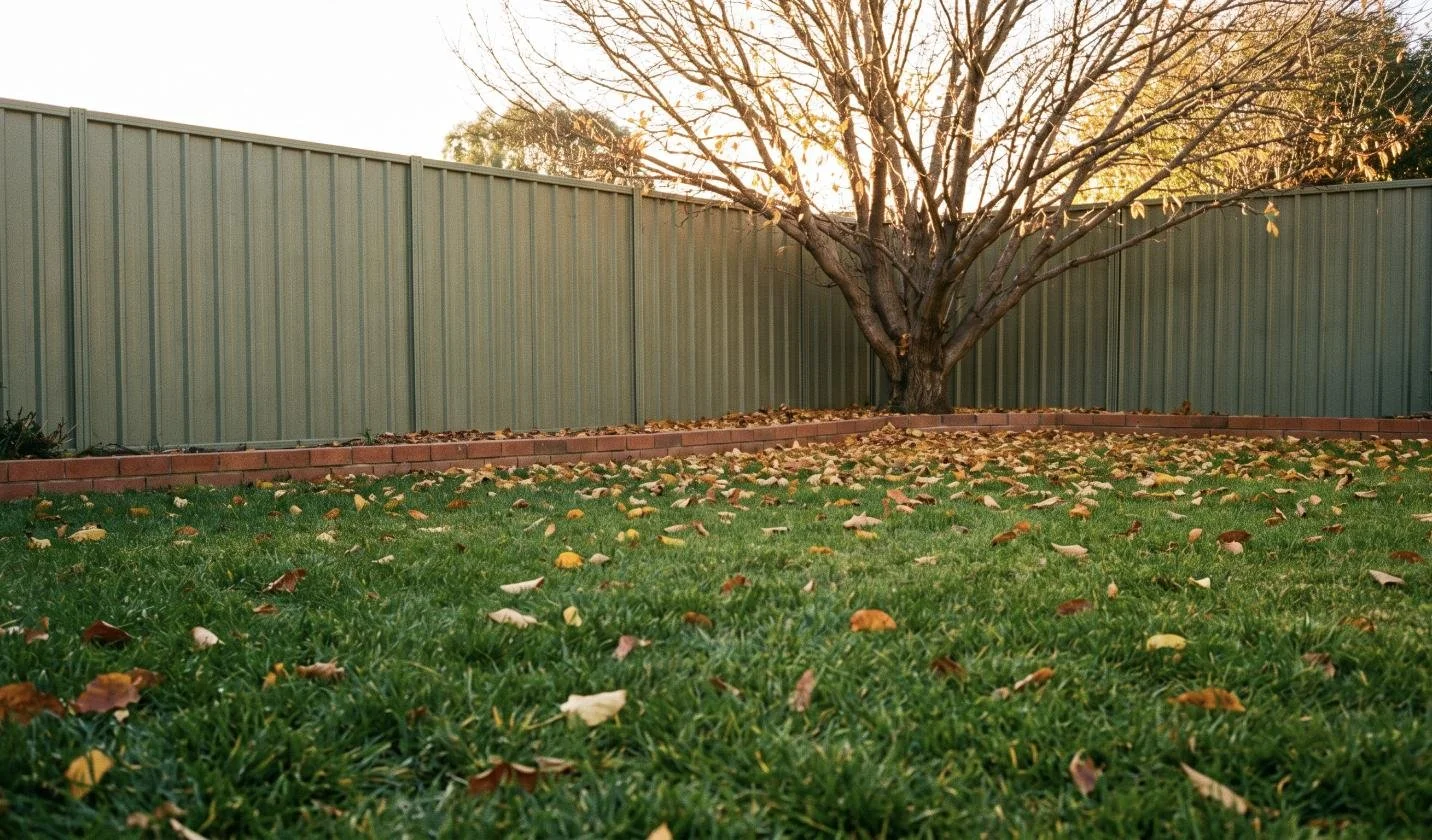
Golden autumn leaves scattered across a healthy green lawn in a Canberra suburban backyard
The quick answer: what autumn lawn care in Canberra actually involves
Autumn lawn care in Canberra means using the March to May window, while the soil is still warm and the heat stress has gone, to repair summer damage and build the root system that carries the lawn through winter frost and next summer.
The short version of my plan:
March: repair summer damage. Core or aerate, top dress, and get seed down while the soil is still warm enough to germinate it.
April: feed properly. This is the single most valuable fertiliser application of the year for a Canberra lawn.
May: tidy up and protect. Get broadleaf weeds under control before winter, raise the mowing height, clear leaf litter and prepare for frost.
If you only do one thing, make it the April feed. If you can do two, add the March coring and seeding. Everything else is refinement.
Why autumn beats spring for a Canberra lawn
Canberra sits in a cool climate zone with hot dry summers and genuinely cold, frosty winters. That combination is hard on turf, and it means our lawns take damage at both ends of the year.
Autumn is the recovery window because three things line up at once.
The soil is still warm. Air temperatures drop away in March and April, but soil holds its heat much longer. Warm soil is what drives root growth and seed germination. In spring you get the opposite problem, where the air warms up before the soil does, so the grass puts on top growth before it has the roots to support it.
The stress has gone. Through January and February the lawn is just surviving. It is not building anything. Once the extreme heat lifts, the plant switches from defence back into growth, and anything you feed it actually gets used.
You have time on your side. Anything you fix in autumn has months to establish before it is asked to perform. Seed sown in March has all of autumn to root down. Fertiliser applied in April is stored in the plant through winter. Compare that to spring repairs, which are racing the clock against the first hot week in November.
That is the difference between guessing and diagnosing. Autumn work is planned work. Spring work is usually catch up.
March: repair the summer damage
By the time we get to March, most Canberra lawns are carrying some combination of thin patches, compacted soil, dry patch and weed invasion. March is when I go after all of it.
Assess before you act. Walk the lawn properly and note what you are actually looking at. Thin patches in high traffic areas are usually compaction. Patches that stay dry no matter how much you water are usually hydrophobic soil, not a watering problem. Irregular dead patches that lift like a rug are usually grubs. A brown patch is not automatically one thing, and treating the wrong cause wastes a season.
Core or aerate. Canberra soils carry a lot of clay, and clay compacts. Compacted soil means water runs off instead of soaking in, roots stay shallow, and thatch builds up. Coring pulls plugs out of the profile and gives you air, water and root space. Autumn is one of the two good windows for it, because the lawn is growing well enough to knit the holes back over. I have written up the full process in my guide to lawn aeration and coring in Canberra.
Deal with thatch if it is there. If you have more than about a centimetre of spongy brown material between the green blades and the soil, water and fertiliser are not reaching the root zone. My guide to lawn thatch in Canberra lawns covers how to tell the difference between healthy thatch and a problem layer.
Top dress and level. Coring and top dressing work well together. The sand or soil blend fills the core holes, smooths out minor dips and improves the surface. If your lawn has become genuinely uneven, my guide to levelling a bumpy lawn goes into more depth.
Get seed down while the soil is warm. This one is time sensitive. Cool season grasses like fescue and rye germinate beautifully in March and early April in Canberra, and much less reliably once the soil temperature drops in May. If your lawn has thinned out over summer, overseeding in March is the highest value job on the list. Leave it until May and you are just feeding the birds.
Worth knowing: if you have a warm season lawn such as couch, kikuyu or buffalo, seeding is not part of your autumn plan in the same way. Those lawns are heading into dormancy, not out of it. Your autumn job is feeding and protecting, not establishing.
April: the most important feed of the year
If you take one thing from this article, take this. The April fertiliser application matters more than any other feed you will do.
Here is why. Through autumn, grass shifts its energy away from producing leaf and into producing roots and storing carbohydrates. A well timed autumn feed goes straight into that process. You are not chasing a flush of green growth. You are building the reserves the plant will draw on through winter dormancy and then use to come out of winter quickly in September.
What that means in practice:
Timing matters more than product. Early to mid April is the sweet spot in Canberra, while the soil still has warmth in it.
A balanced feed with a decent potassium component is what I want going into a frost season, because potassium is tied to cold tolerance and root strength.
Feeding too heavily and too late, with a high nitrogen product in May, pushes soft leafy growth right when the first frosts arrive. That soft growth is exactly what gets burnt.
I go through rates, products and timing in detail in my complete guide to lawn fertilisation in Canberra.
One thing I will not do is guess at what your lawn needs. Canberra soils vary enormously from suburb to suburb and even from front yard to back yard. If your lawn has been underperforming for a couple of seasons despite reasonable care, a soil test will tell you what is actually missing rather than what a bag label assumes.
Book a Free Assessment and I will look at your lawn, your soil and your grass type before recommending anything.
Autumn weed control: the window most people miss
Autumn is when winter weeds germinate in Canberra. Bindii, winter grass, capeweed and clover all establish in the cool damp conditions of April and May, then sit there quietly through winter before making themselves obvious in August and September.
By the time you notice bindii prickles in spring, the plant has already been growing for months and is far harder to control. The efficient approach is to interrupt it in autumn.
Pre emergent in autumn targets winter weed seeds before they germinate. Timing is everything with pre emergent, and it is genuinely easy to get wrong. My guide to pre emergent weed control in Canberra lawns covers the timing question properly.
Selective control of what is already up works well in autumn because the weeds are small and actively growing.
Identify before you treat. Different weeds need different approaches, and a few common Canberra weeds are not controlled by the standard broadleaf products at all. My guide to common lawn weeds in Canberra will help you work out what you are looking at.
If you have a buffalo lawn, be careful here. Buffalo is sensitive to several herbicides that are perfectly safe on couch, kikuyu or fescue, and the wrong product will thin or damage it. This is one of the areas where I would rather diagnose than have you guess.
May: protect the lawn going into winter
May is the wind down month. The work is lighter but it still matters.
Raise the mowing height. Longer leaf means more surface area for photosynthesis during the short low light days of a Canberra winter, and it insulates the crown of the plant against frost. Going into winter scalped is one of the most common reasons a lawn looks awful in July.
Keep leaves off the grass. Canberra has a lot of deciduous street trees and a heavy leaf drop through May. A mat of wet leaves sitting on the lawn blocks light, holds moisture against the leaf and creates ideal conditions for fungal disease. Clear them regularly rather than letting them build up.
Ease off the water, but do not stop. Rainfall usually improves in autumn, so irrigation needs drop away. Just do not switch it off entirely. Dry frosty conditions in late autumn can still stress a lawn, and dry soil freezes harder than moist soil.
Watch for disease. Cool nights, heavy dew and reduced airflow are what fungal disease likes. If you start seeing rings, patches or discoloured blades, my lawn disease guide for Canberra will help you narrow down what you are dealing with.
Check for grubs one last time. Grub damage often shows up in autumn after a summer of feeding. If patches are lifting easily or you are seeing more birds working the lawn than usual, have a look. My guide to lawn pest control in Canberra covers how to check properly.
How autumn changes by grass type
Not every Canberra lawn wants the same autumn.
Cool season lawns such as tall fescue and rye are in their best growing period in autumn. Feed them, seed them, core them, and expect real growth and recovery. This is their season.
Warm season lawns such as couch, kikuyu, buffalo and zoysia are slowing down towards winter dormancy. Feed them in early autumn rather than late, do not seed them, and be conservative with anything that removes leaf material late in the season. They need what they have to get through winter.
If you are not certain which you have, my guide on identifying your grass type will sort it out in a few minutes. It genuinely changes the whole plan.
Final word
Autumn is the season where the work is least visible and most valuable. Nobody walks past a lawn in April and admires the coring holes. But the lawn that gets cored, fed, seeded and weeded in autumn is the lawn that comes out of a Canberra winter green in September while the neighbours are still looking at a brown mat.
The catch is that the window is narrower than people think. Miss the March soil warmth for seeding, or push the main feed into late May, and you have lost most of the benefit. That is why I plan autumn rather than react to it, and why an autumn programme sits at the centre of my year round lawn maintenance programme.
If you would like me to look at your lawn and tell you exactly what it needs this autumn, rather than working from a generic checklist, Book a Free Assessment and I will come and diagnose it properly.
Key points I get asked on a regular basis
When does autumn lawn care start in Canberra?
I start in early March, as soon as the extreme summer heat has broken. The exact date moves around each year, and the trigger I watch is night time temperatures dropping away consistently while the soil is still warm. Practically, that is usually the first two weeks of March in Canberra. Waiting until the calendar says autumn has properly arrived often means you have already lost the best seeding conditions.
Should I fertilise my lawn in autumn or wait until spring?
Both, but if you can only do one, do autumn. The autumn feed goes into root growth and carbohydrate storage, which is what carries the plant through winter and gets it moving quickly in spring. A spring only feeding programme means the lawn spends winter running on empty. Aim for early to mid April in Canberra and avoid heavy nitrogen applications in late May, because soft new growth going into frost season gets damaged.
Can I plant grass seed in autumn in Canberra?
Yes, and March into early April is one of the two best seeding windows of the year here, because the soil is still warm enough for reliable germination while the air is cool enough that the seedlings are not heat stressed. The important thing is not to leave it too late. By mid May the soil has usually cooled enough that germination becomes slow and patchy. This applies to cool season grasses. Warm season lawns are not seeded in autumn.
Should I aerate or core my lawn in autumn?
Autumn is a good window for coring in Canberra, particularly on the clay soils common across the region. The lawn is still growing well enough to recover and knit over the holes, and the improved water and air movement sets you up for winter. I would core in March or early April rather than May, so the lawn has time to close up before growth slows. If the lawn is already thin and stressed, deal with the cause first rather than adding more disturbance.
How short should I mow my lawn going into winter?
Higher than you have been mowing through summer. More leaf means more light captured during short winter days and better insulation for the crown of the plant against frost. Scalping a lawn late in autumn is one of the most reliable ways to make it look terrible in July. Raise the height gradually through May rather than in one cut, and keep the blade sharp, because a torn leaf tip is an entry point for disease.
How do I book autumn lawn care in Canberra?
The easiest way is to Book a Free Assessment. I will come out, look at your grass type, your soil and the condition the lawn is in after summer, and then tell you what your lawn actually needs this autumn rather than handing you a generic checklist. From there we can either sort out a one off autumn treatment or set you up on a year round programme, whichever suits you. There is no cost and no obligation for the assessment itself.

Looking for the perfect gift for the lawn enthusiast in your life? The Lawn Firm Gift Cards are the ideal solution. Redeemable for any of our professional lawn care services, these gift cards make it easy to give the gift of a greener, healthier lawn. From fertilisation to weed control and pest management, there’s something for every lawn need.
Why Choose a Lawn Firm Gift Card?
Versatility: Can be used for any service offered by The Lawn Firm.
Thoughtful Giving: A practical gift for anyone who values a beautiful outdoor space.
Simple to Use: Purchase online and enjoy easy redemption.
Order your gift card today and let your loved ones experience the professional touch of The Lawn Firm. It’s the perfect way to show you care while helping someone achieve the lawn of their dreams.
This gift card never expires.