
Ants in Canberra Lawns: When They Matter and What to Do
G'day, Nikolai here from The Lawn Firm. If you have been watching little piles of soil appear across the lawn, wondering whether the ants are eating your grass and what you can spray on them, I want to save you some money and some worry. I have almost never found a Canberra lawn genuinely ruined by ants. What I find instead is a lawn with a soil problem that the ants moved into because the conditions suited them. The ants are the thing you noticed. They are rarely the thing that is wrong.
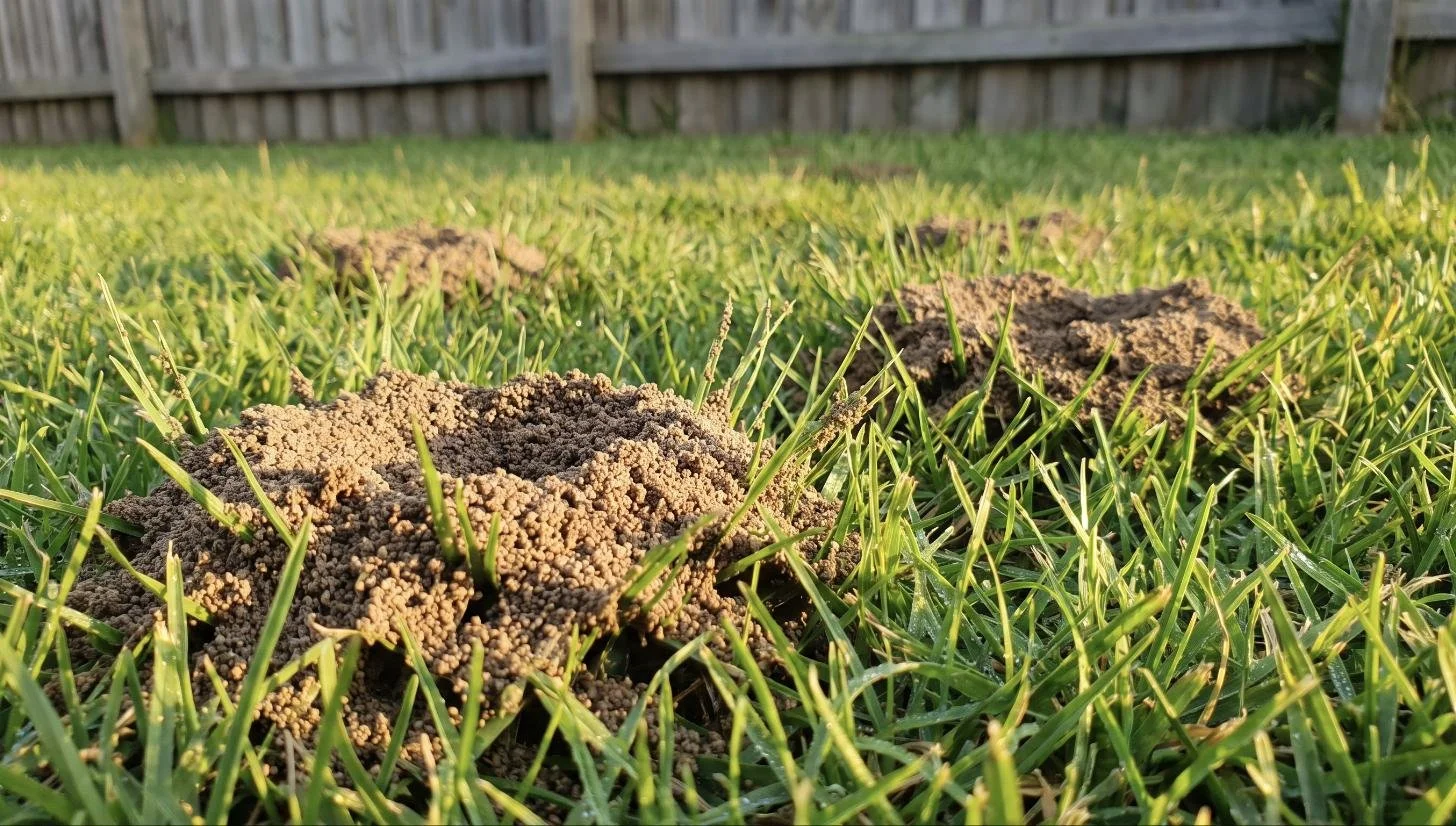
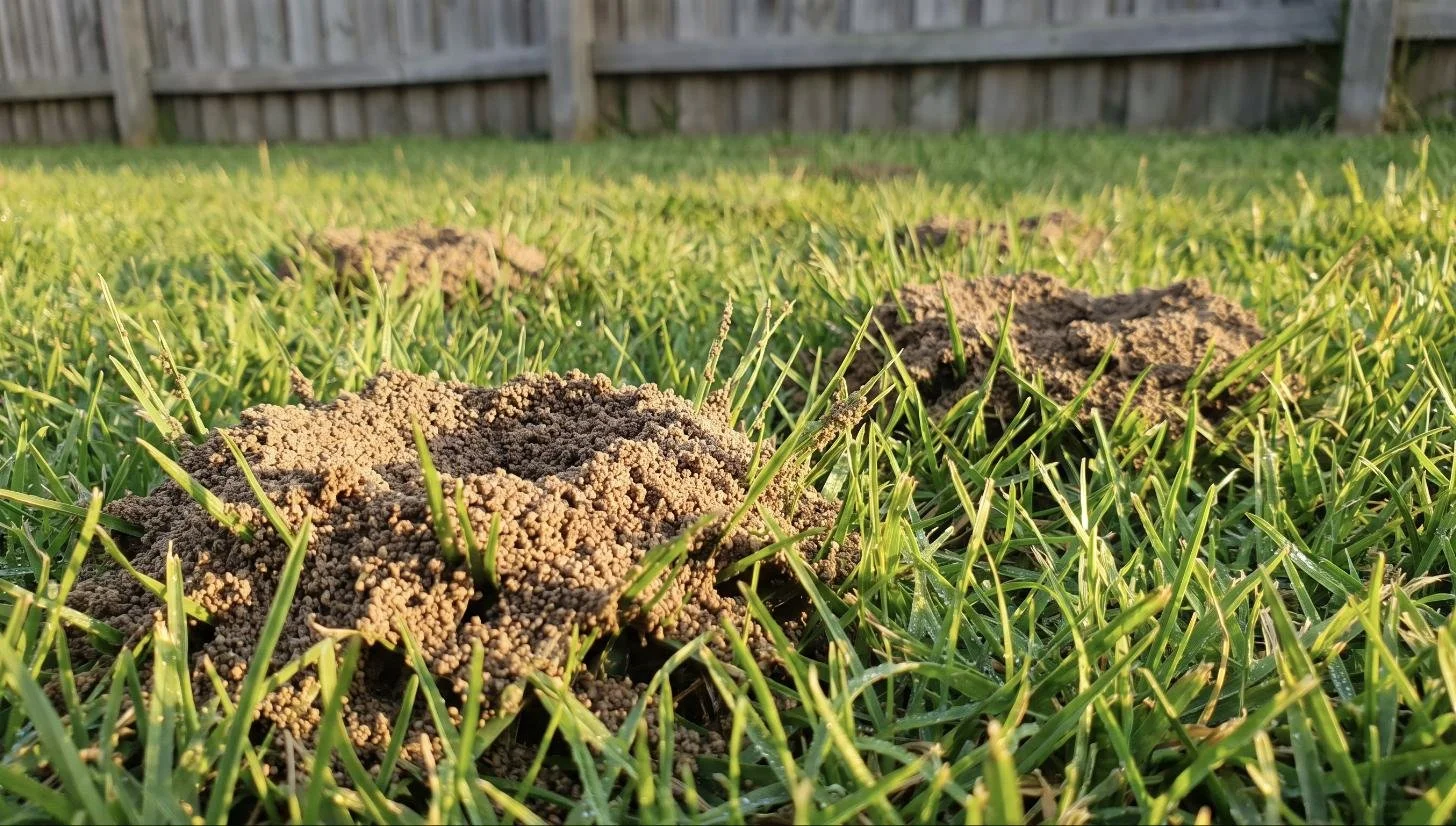
Ant activity in a Canberra lawn, with excavated soil sitting on top of the leaf and dry turf above the nest.
The quick answer:
Ants do not eat grass and they rarely damage a lawn directly. The damage you see is secondary: excavated soil smothering the leaf, tunnelling drying out the root zone, and mounds making the surface uneven. Because ants strongly prefer dry, loose, low organic matter soil, a sudden ant explosion usually signals that your soil is drying out and water is not penetrating, so fixing the soil normally does more good than spraying.
What ants actually do in a lawn
Ants have no interest in your grass as food. They are not chewing roots like a lawn grub, and they are not sucking the leaf like an aphid. They are builders and foragers, and what they do to a lawn, they do incidentally. Here is the real list of problems I see:
Soil excavation on top of the leaf. As ants dig their galleries they carry the spoil up and dump it on the surface, where it shades and smothers low growth. A thin scattering is nothing, but weeks of heavy excavation will thin the turf underneath.
Root zone drying. Tunnels and chambers create air gaps right where the roots are, so water pours through instead of being held and the soil around the nest dries faster. That is why turf over an established nest looks pale and stressed while the lawn a metre away looks fine.
Surface unevenness. Mounds and loose spoil make the lawn lumpy, and you feel it underfoot before you see it. If that is your main complaint, it is a levelling job more than a pest one.
Undermining edges and paving. Ants nest happily in the sand bed under pavers and along garden edging, and over a few seasons they shift enough material to let pavers rock and settle.
Nuisance and nipping. Some species bite or sting, and when the nest is where the kids play, that matters whether or not the grass cares.
Four of those five problems are about soil and structure, not the insect itself.
Why an ant explosion is a signal worth reading
Ants are fussy about where they build. They want soil that is dry, loose, well drained, easy to tunnel through and low in organic matter. Wet, dense, biologically active soil is a poor nest site. So when a lawn that had a handful of ants last year suddenly has nests everywhere, I do not read that as an invasion. I read it as a change in the soil, and nine times out of ten the soil has gone dry and water repellent.
Canberra is tailor made for this. We get hot, dry stretches, sandy loam soils in the newer suburbs, builder's fill in plenty of established ones, and irrigation doing less than the owner thinks. When the top few centimetres dry out hard, waxy residues coat the soil particles and the soil turns hydrophobic. Water beads up or disappears down a crack and bypasses the root zone, so the lawn gets thirstier while the hose runs. I go into the mechanics in hydrophobic soil in Canberra lawns.
The clue is in the pattern. Ask yourself:
Did the ants arrive at the same time as dry patches that will not green up no matter how much you water?
Are the nests concentrated in the spots that were always driest, like north facing slopes, strips along concrete, or the corner the sprinkler barely reaches?
Does water bead on the surface before soaking in, or run sideways to the lowest point?
If you are nodding along, the ants are a symptom. Treat them in isolation and you will be doing it again next summer.
When ants genuinely need treating
I am not anti treatment. I just want it pointed at a real problem. Here is where control is justified.
Nests in high traffic or play areas. If the nest is where small kids sit or across the path to the clothesline, the grass is not the issue. Being bitten is.
Stinging or aggressive species. If anyone is getting stung in their own backyard, that is a priority and I do not philosophise about soil first.
Structural undermining. Nests under pavers or along a driveway edge do cumulative damage that costs real money to put right.
Heavy mound coverage. When spoil goes down faster than the lawn can grow through it, across a meaningful area, the smothering becomes a real turf health problem.
Nests invading the house, which is often a job for a licensed pest technician rather than a turf programme.
And here is where I honestly suggest leaving them alone:
A scattering of small nests in a healthy, dense, well watered lawn. They do no harm, and some tunnelling helps water and air move through soil.
Nests in the back fence line, under shrubs or in beds where nobody walks.
A short seasonal burst after rain or a warm spell, which often settles by itself.
Any case where the real complaint is dry patches or thin turf. Fix that and the ant pressure usually drops away on its own.
The diagnostic order I use
When someone calls me about ants, I do not start with the ants. I work through this order, and it almost always changes what gets recommended.
Confirm what I am looking at. Nest entrances, spoil heaps and ant trails, and rule out the look alikes. Earthworm castings, mole cricket activity and fungal patches all get blamed on ants, and grub damage gets mistaken for it constantly, which is a completely different treatment path. I cover the signs in lawn grubs, beetles and armyworms.
Map where they are, not just that they are there. Nests clustered in the driest parts of the lawn tell a different story to nests spread evenly everywhere. The map is usually the diagnosis.
Test whether water is going in. I dig a small plug and look at where the moisture stops. If the top few centimetres are dry and crusted, or the whole profile is dry despite regular watering, I have found the actual problem.
Check the irrigation and the watering habit. Short, frequent watering on hydrophobic soil never gets past the repellent layer, and badly spaced sprinklers create the dry zones ants love.
Look at organic matter and soil structure. Thin, sandy, lifeless soil holds no water and makes easy digging, and both favour ants. A soil test tells me what the soil is short of.
Check whether the ants are telling me about a second pest. Ants farm aphids, scale and mealybug for the honeydew those insects excrete, and protect them from predators, so a persistent ant trail up a tree or along a hedge beside the lawn often means a sap sucking problem there is feeding them. If the ants have a food source, removing lawn nests will not reduce the pressure much.
Only then decide whether any pest treatment is warranted, and what kind.
Why killing the ants without fixing the soil just invites them back
Picture a bare, dry, loose patch of soil in your lawn. If you remove every ant from it today, what has changed about that patch? Nothing. It is still the best nest site in the yard, and there are colonies in the garden beds and the verge looking for exactly that. You can knock back the ants that are there, but you have not changed why they chose the spot, so the patch gets recolonised and the owner concludes the treatment failed when really it was aimed at the wrong target.
The flip side surprises people. Fix the soil and the ant pressure often drops without any insecticide at all, because you have made the site a poor one. What that usually looks like:
A quality wetting agent to break down the water repellency so irrigation reaches the root zone. This is the highest value move on most dry Canberra lawns, and I explain how they work in lawn wetting agents in Canberra.
Correcting the irrigation. Fewer, longer, deeper waterings instead of a daily sprinkle, and fixing the coverage gaps so dry corners stop being dry.
Adding organic matter so the soil holds moisture and builds some structure and biology. Top dressing does this and evens out old mounds at the same time.
Relieving compaction with aeration and coring where water runs off instead of soaking in.
Thickening the turf through sensible fertilising, because a dense lawn shades the soil and is a far less attractive nest site than a thin one.
When pest treatment is genuinely the right call, it has to be matched to the species, the nest type, the location and the time of year, and that is an on site decision. I will not list products or rates here, because getting it wrong wastes money. For how I approach pests in turf generally, lawn pest control in Canberra sets out the logic.
Final word
Ants are the most over treated and under read problem I see in Canberra lawns. They do not eat your grass. They move in when the soil has gone dry, loose and hungry, then make it slightly worse by piling spoil on the leaf and drying the root zone from underneath.
So when they turn up in numbers, treat it as a message rather than an attack. Check whether water is actually getting into your soil, because more often than not that is the fault, and dealing with it does more for the lawn than any spray would have. Where treatment is warranted, and sometimes it genuinely is, it should come after that diagnosis rather than instead of it. What I am always arguing against is guessing.
Key points I get asked on a regular basis
Do ants eat grass or damage lawn roots?
No. Ants are not feeding on your grass or chewing its roots. They are scavengers and honeydew farmers, and the lawn is just somewhere convenient to build. Any damage you see is a by product of their digging, a very different problem to a grub actively eating the plant.
Why is the grass dying above an ant nest?
Because of what the tunnelling does to water. The galleries create air gaps through the root zone, so water drains straight past instead of being held where the roots can use it, and the soil around the nest dries faster than the soil either side. Spoil dumped on the leaf then shades the growth underneath.
Does a lot of ants mean my soil is unhealthy?
Often, yes, which is why the explosion is worth paying attention to. Ants prefer dry, loose, well drained soil with low organic matter, a fair description of hydrophobic or depleted lawn soil. A sudden increase in nests, especially in the driest areas, usually means water is no longer penetrating, so I would check the soil moisture profile before doing anything else.
Will killing the ants fix the bare patches in my lawn?
Usually not on its own. If the patch is bare because the soil there is dry and water repellent, removing the ants leaves it just as attractive to the next colony. Addressing the water repellency, the irrigation coverage and the organic matter is what changes the outcome, and it tends to reduce ant pressure as a side effect.
What does it mean if ants are climbing my trees or hedge?
It usually means they have found aphids, scale or mealybug up there. Those insects excrete honeydew, the ants harvest it, and in return they defend the colony from predators. So a persistent ant highway up a trunk is a clue that you have a sap sucking insect problem on that plant, and it explains why the ants are thriving. Deal with the honeydew source and you remove much of their food supply.
How do I book an ant and lawn pest assessment in Canberra?
Get in touch and I will come out and have a proper look. I will identify what is nesting in your lawn, check whether your soil is holding water or shedding it, and tell you honestly whether treatment is worth doing or whether your money is better spent on the soil. If ongoing care makes sense, we can talk through a lawn maintenance programme that keeps the turf dense enough to be a poor nest site in the first place.
Looking for the perfect gift for the lawn enthusiast in your life? The Lawn Firm Gift Cards are the ideal solution. Redeemable for any of our professional lawn care services, these gift cards make it easy to give the gift of a greener, healthier lawn. From fertilisation to weed control and pest management, there’s something for every lawn need.
Why Choose a Lawn Firm Gift Card?
Versatility: Can be used for any service offered by The Lawn Firm.
Thoughtful Giving: A practical gift for anyone who values a beautiful outdoor space.
Simple to Use: Purchase online and enjoy easy redemption.
Order your gift card today and let your loved ones experience the professional touch of The Lawn Firm. It’s the perfect way to show you care while helping someone achieve the lawn of their dreams.
This gift card never expires.