
Stopping Couch and Kikuyu Invading Your Garden Beds in Canberra
G'day, Nikolai here from The Lawn Firm. If you have spent a Saturday on your knees pulling runners out of a garden bed, only to find them back in six weeks, you are not failing because you are careless. You are failing because the plant you are fighting is built to survive exactly what you are doing to it. Almost every weed article I write is about something invading the lawn. This one is the inverse: here the lawn is the weed.
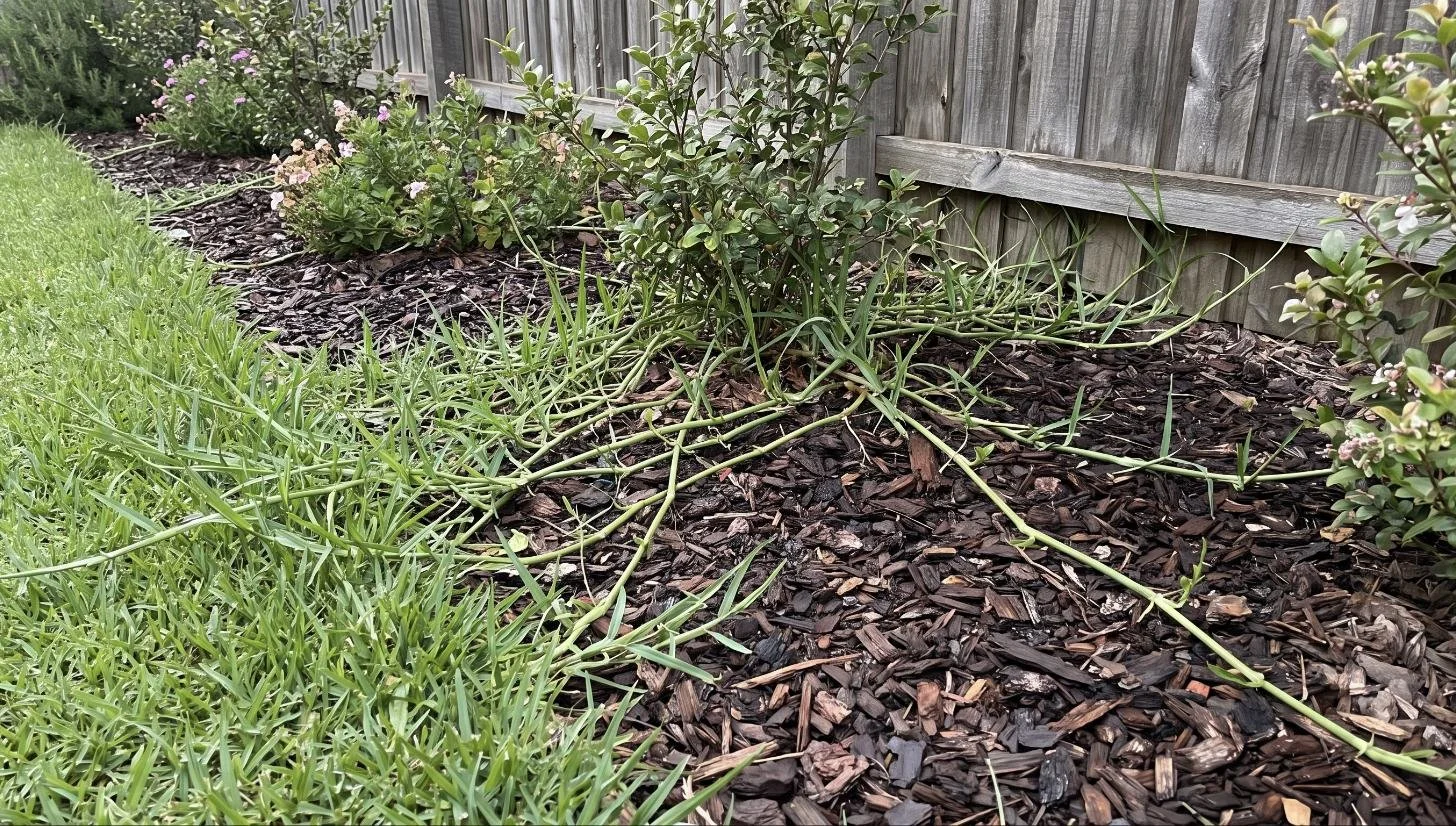
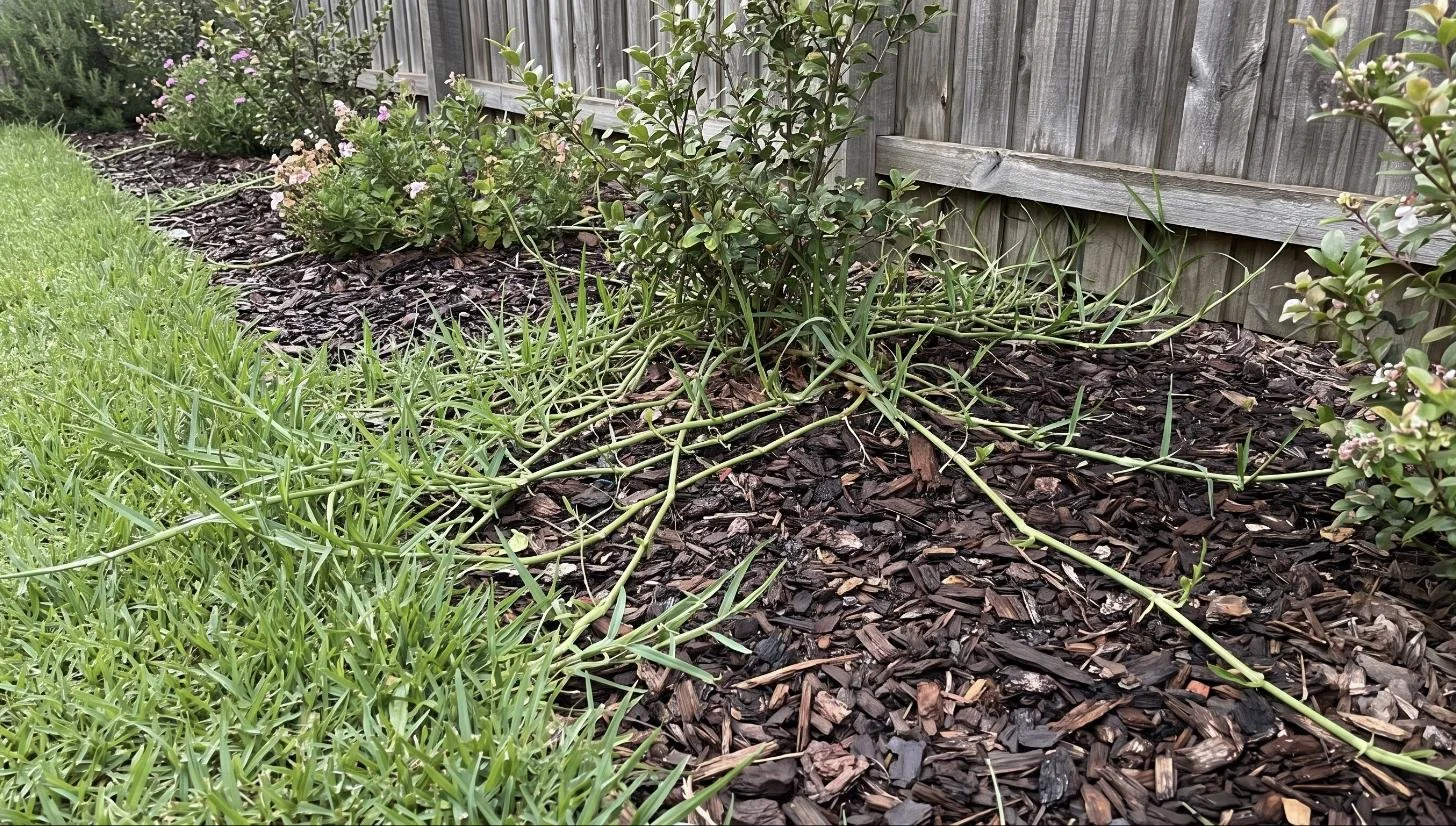
Kikuyu runners creeping through mulch into a Canberra garden bed, the point where most homeowners first notice the problem.
The quick answer:
Couch and kikuyu invade garden beds because they spread by above-ground stolons and below-ground rhizomes, so cutting or pulling the visible runner leaves nodes behind that simply reshoot. Mulch alone will never stop them, because they travel under it and through it. What holds a bed edge is three layers working together: a physical root barrier set deep enough to beat the rhizomes, a maintained mechanical edge that severs the surface runners, and selective treatment of whatever still gets through. Identify your lawn grass before any treatment near a bed, because several commonly used selective herbicides will damage buffalo.
Why couch and kikuyu do this and other grasses do not
Which grass you have tells you how hard this fight will be.
Kikuyu is the most aggressive runner grass I deal with in Canberra. Thick stolons race across the soil and over the top of mulch, while rhizomes travel down and sideways underground. Those rhizomes are the part homeowners underestimate: you can clear every visible runner and still have a network ready to push up new shoots a fortnight later. Kikuyu also roots at the nodes, so every point where a runner touches soil becomes an anchored plant. More on its seasonal behaviour is in my guide to kikuyu grass lawn care in Canberra.
Couch is a close second, and because the runners are finer it is sneakier. The rhizomes travel a surprising distance under a path or an edge and surface well inside a bed, and the fine stolons weave through mulch rather than sitting on it. By the time you notice couch in a bed it is usually well established. My notes on its habit are in the couch grass lawn care guide.
Buffalo spreads by stolons only, with no rhizomes, which is genuinely good news for your beds. It will still creep over an edge, but because the spread is all above ground you can see it, cut it and contain it with far less structural work. More in my buffalo grass lawn care notes.
Tall fescue is clumping. It grows from the crown, does not run, and barely encroaches. If fescue turns up in your bed it almost always arrived as seed, a different problem entirely.
If you are not certain which grass you have, sort that out first, because every treatment decision hangs off it. My walkthrough on how to identify your grass type in Canberra will get you there in minutes.
Why pulling runners out of mulch never works
When you grab a runner and pull, it snaps and you get a metre of green and none of the root system, or it tears free and leaves every rooted node in the soil, or at best you get a decent length out and still leave the rhizome that fed it. The plant does not die. It reshoots.
Worse, fragmentation is a propagation strategy, not a setback. Every piece of stolon or rhizome with a viable node is a new plant waiting for water, so pulling runners and shaking soil and mulch about is effectively taking cuttings and planting them.
Related traps I see regularly:
Rotary hoeing or turning over a bed with couch or kikuyu in it. This chops rhizomes into hundreds of pieces and spreads them evenly, the fastest way to turn a bad edge into a full infestation.
Topping up mulch over existing runners. Fresh mulch holds moisture and the stolons root into it.
Leaving pulled material on the bed or a compost pile nearby. Kikuyu re-roots from a discarded runner.
Attacking it hard once in spring and not looking again until autumn. The reshoot window is weeks.
Hand-weeding is a tidying tool for the last few shoots, not a control method.
The three layers that actually work
Any one of these on its own leaks. Together they hold the line.
Layer one: a physical root barrier
This is the layer most people skip, and it does the heavy lifting against rhizomes. A barrier is a solid vertical sheet set into the ground along the bed line, so underground stems hit it and cannot pass.
The critical variable is depth, not material. A barrier that only goes 50 to 75mm into the soil is decorative, because couch and kikuyu rhizomes travel comfortably below that and surface on the other side. Across Canberra gardens you want at least 150mm into the soil for couch, and 200mm or more where kikuyu is established. Plenty of blocks here hit shale or compacted fill before that, which is better settled on site than guessed from a blog.
On materials, roughly in order of how well they hold up here:
Concrete or masonry edging set properly into the ground. Most durable, most work to install, and a clean edge to mow to.
Rigid HDPE or polyethylene root barrier. Good depth for the money, flexible around curves, does not rot. Do the joins properly, because a gap in a barrier is a door.
Steel edging, corten or galvanised. A crisp line, but much off-the-shelf steel comes in shallow profiles that will not stop rhizomes.
Treated timber. Affordable, but a consumable: as it moves and decays it opens pathways.
Thin plastic edging from the hardware aisle. A visual line only, too shallow to be a barrier.
Two details matter as much as the material. The top should sit at or just above soil level, because a buried top lets the stolons run over. And continuity counts, since runners find the one gap at the gate or the corner you could not quite reach.
Layer two: a maintained mechanical edge
The barrier handles what happens underground. The edge handles what happens on top.
Stolons do not care about your barrier because they travel above it. A clean cut line along the bed, made with an edger or a sharp spade, breaks the connection between the parent plant and whatever has crept over. Cut off from the lawn, a runner is a small isolated plant, much easier to deal with.
Through the warm months, with kikuyu in full gear, every two to three weeks keeps you in front of it. Couch is a little slower, and buffalo you can usually manage monthly. Over winter, with the warm season grasses dormant, you get a genuine break. Edge to a consistent depth so you are cutting runners rather than trimming overhanging blades, and edge before you top up mulch, not after.
Layer three: selective treatment of what gets through
Even with a good barrier and a disciplined edge, some grass gets through. The third layer is treating those escapees deliberately rather than tearing at them, and this is where identification becomes non-negotiable.
The buffalo problem, and why identification comes first
Several selective herbicides commonly used on grassy weeds will damage buffalo, in some cases badly. Buffalo has a known sensitivity to certain active groups that couch, kikuyu and fescue tolerate without much complaint. A product perfectly safe on one Canberra lawn can thin, yellow or kill patches on the lawn next door.
The risk is highest right at the bed edge, where overspray, drift and runoff concentrate and the grass you want to kill is touching the grass you want to keep. So the order is fixed: identify the lawn grass, confirm what else is growing around the bed, then decide on treatment. If you are not sure what you have, do not spray near that edge.
For the same reason I will not publish rates or product names with rates. Choice of active, rate, timing, surrounding plants, lawn health and the weather ahead all change the right answer. Diagnostically:
Treatment works far better on actively growing grass than on stressed or dormant grass, which puts the useful window in the warmer months here.
Cutting the edge first and treating the isolated regrowth beats treating a runner still connected to a healthy lawn.
Repeat applications are usually part of the plan, because rhizomes hold reserves and one pass rarely finishes the job.
Ornamentals, natives or edibles nearby need a plan for protecting them.
For a picture of what else might be in that bed, my notes on common lawn weeds in Canberra will help you tell a grass runner from a genuine weed.
Why mulch is not a barrier
Mulch holds moisture, suppresses seed-germinated weeds and makes a bed look finished. What it does not do is stop a runner grass. Rhizomes travel below it entirely, and stolons travel across and through it, rooting into damp mulch more readily than into dry soil.
Weed mat helps a little with seed and almost nothing with runners. I regularly lift mat in Canberra beds and find kikuyu rhizomes underneath and stolons running along the top, using it as a flat highway. Mat earns its place under gravel or stone, and even there it is a seed suppressant, not a root barrier.
The long game: this is maintenance, not a cure
There is no one-off fix for couch or kikuyu encroachment. The lawn is alive and it will keep trying. What the three layers give you is a shift from losing battle to routine upkeep.
On a badly invaded bed, the first season is reclamation: the barrier goes in, the edge gets established, and the existing runners get dealt with over several passes rather than one. The second season is consolidation, catching new attempts early while the old rhizome reserves run down. After that the time commitment drops a lot.
A thick, well-fed lawn still runs, but a thin, stressed one runs into every gap it can find. Keeping the lawn on a sensible seasonal programme is part of bed protection, which is the thinking behind my Canberra lawn maintenance programme.
Final word
This problem frustrates people because the usual instinct, to pull the thing out, is the one approach that reliably fails. Couch and kikuyu are vigorous grasses doing exactly what they were selected to do, which is cover ground fast and hold on. You will not out-pull them. What you can do is change the geometry: something solid in the ground deep enough that the rhizomes cannot pass, a cut line that severs the stolons regularly, and deliberate treatment of the leftovers with the grass identified first.
Key points I get asked on a regular basis
Can I just spray the grass in my garden bed and be done with it?
Not without identifying your lawn grass first. A single spray knocks down the visible growth, but couch and kikuyu hold reserves in their rhizomes and reshoot. More importantly, if your lawn is buffalo, several commonly used selective products will damage it, and the bed edge is exactly where that damage happens.
How deep does a root barrier actually need to be?
Deeper than most off-the-shelf garden edging. A barrier sitting 50 to 75mm into the soil is a visual line only, because couch and kikuyu rhizomes travel well below that. Aim for at least 150mm for couch, and 200mm or more for established kikuyu.
Will weed mat under my mulch stop the grass?
It helps a little with seed-germinated weeds and almost nothing with runner grasses. I routinely find kikuyu rhizomes under weed mat and stolons running along the top of it. Mat has a role under gravel and stone as a seed suppressant, but it is not a root barrier.
Why does my buffalo creep into the bed but not seem as bad as my neighbour's kikuyu?
Because buffalo spreads by stolons only and has no rhizomes. All of its spread is above ground, where you can see it and cut it, so a maintained edge does most of the work. Kikuyu attacks from above and below at once, which is why it needs the full three layers.
Is it worth hand-pulling at all, or should I never touch it?
Hand-pulling is fine for the last few isolated shoots once the barrier and edge are in place. What it is not is a control method, because every node you leave reshoots and every fragment you scatter can become a new plant.
How do I book a lawn and garden bed assessment in Canberra?
The easiest way is to get me out to look at it, so I can identify your lawn grass, see how far the runners have travelled and what depth your soil will take, and give you a realistic plan for the barrier, the edge and any treatment. Book a Free Assessment
Looking for the perfect gift for the lawn enthusiast in your life? The Lawn Firm Gift Cards are the ideal solution. Redeemable for any of our professional lawn care services, these gift cards make it easy to give the gift of a greener, healthier lawn. From fertilisation to weed control and pest management, there’s something for every lawn need.
Why Choose a Lawn Firm Gift Card?
Versatility: Can be used for any service offered by The Lawn Firm.
Thoughtful Giving: A practical gift for anyone who values a beautiful outdoor space.
Simple to Use: Purchase online and enjoy easy redemption.
Order your gift card today and let your loved ones experience the professional touch of The Lawn Firm. It’s the perfect way to show you care while helping someone achieve the lawn of their dreams.
This gift card never expires.