
Fertiliser Burn on Canberra Lawns: Why It Happens and How to Repair It
G'day, Nikolai here from The Lawn Firm. If you fertilised in the last week and you are now looking at yellow or brown streaks where the grass used to be green, I know how that feels, and I know the clock is ticking. Fertiliser burn is one of the few lawn problems where what you do in the next few hours genuinely changes the outcome, so let me give you the action first and the explanation second.
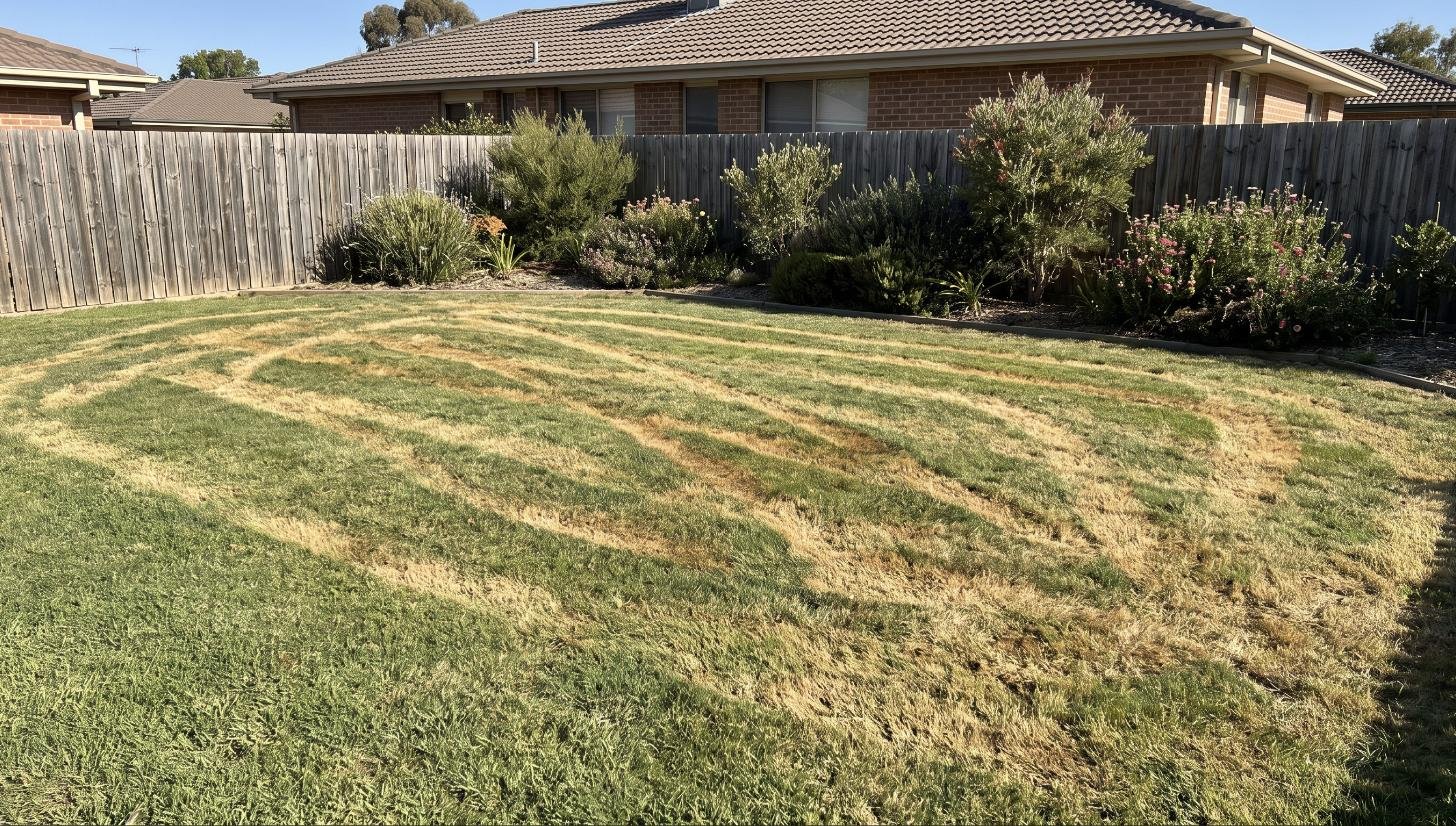
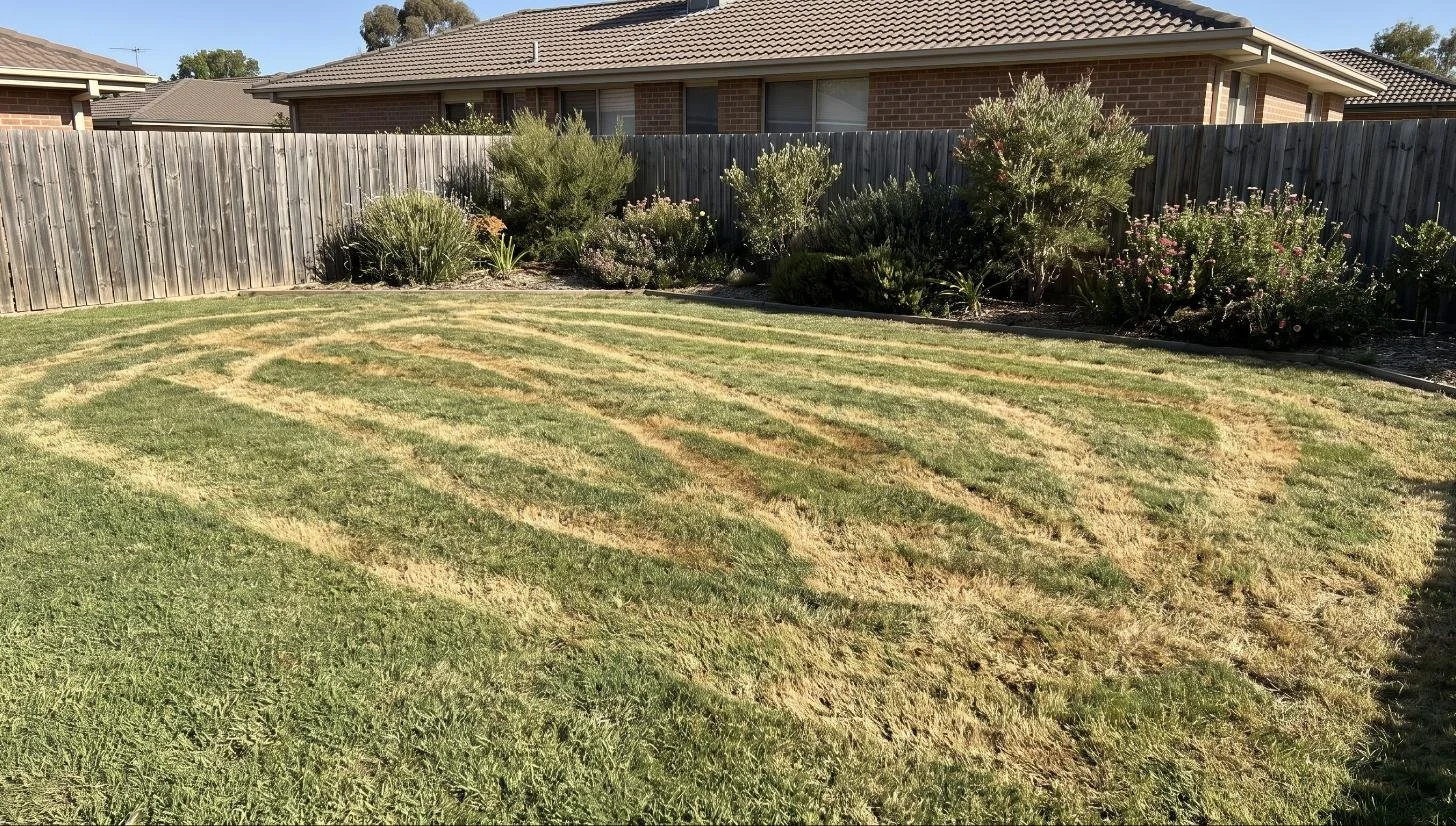
Classic fertiliser burn on a Canberra lawn, with the damage following the pattern of the spreader passes.
The quick answer:
Water heavily and immediately. Soak the affected area deeply, at least fifteen to twenty minutes per zone, and repeat daily for three to five days so the excess salts flush past the root zone instead of sitting against the leaf and crown. If the crown at the base of the plant is still firm and pale green when you part the grass, the lawn will usually grow out of it over two to six weeks. If the crown pulls away dry and brittle, that patch is dead and needs seeding or turf.
How to recognise fertiliser burn
Fertiliser burn has a signature, because the damage follows a pattern made by a machine rather than by nature. What I look for:
Stripes, bands or a checkerboard of yellow to straw brown, in straight lines
Darker, more severely burnt lines where two spreader passes overlapped
Sharp edges rather than a soft fade into healthy grass
Timing that lines up, usually two to seven days after fertilising
Worst damage on slopes and high spots, and anywhere thin or sandy
Occasionally a scorched boot print or wheel track in wet grass
The pattern is the giveaway. Grass does not go off in neat parallel lines on its own.
Telling it apart from other causes
I get called to plenty of lawns where the owner has blamed the fertiliser and the real cause is something else. The diagnosis matters, because the treatments pull in opposite directions.
Drought stress shows up as irregular patches on the hottest, driest parts of the lawn, often near concrete or over buried rubble. The grass greys off before it browns, footprints stay visible, and there are no straight lines. If water beads up and runs off instead of soaking in, you have hydrophobic soil rather than a fertiliser problem.
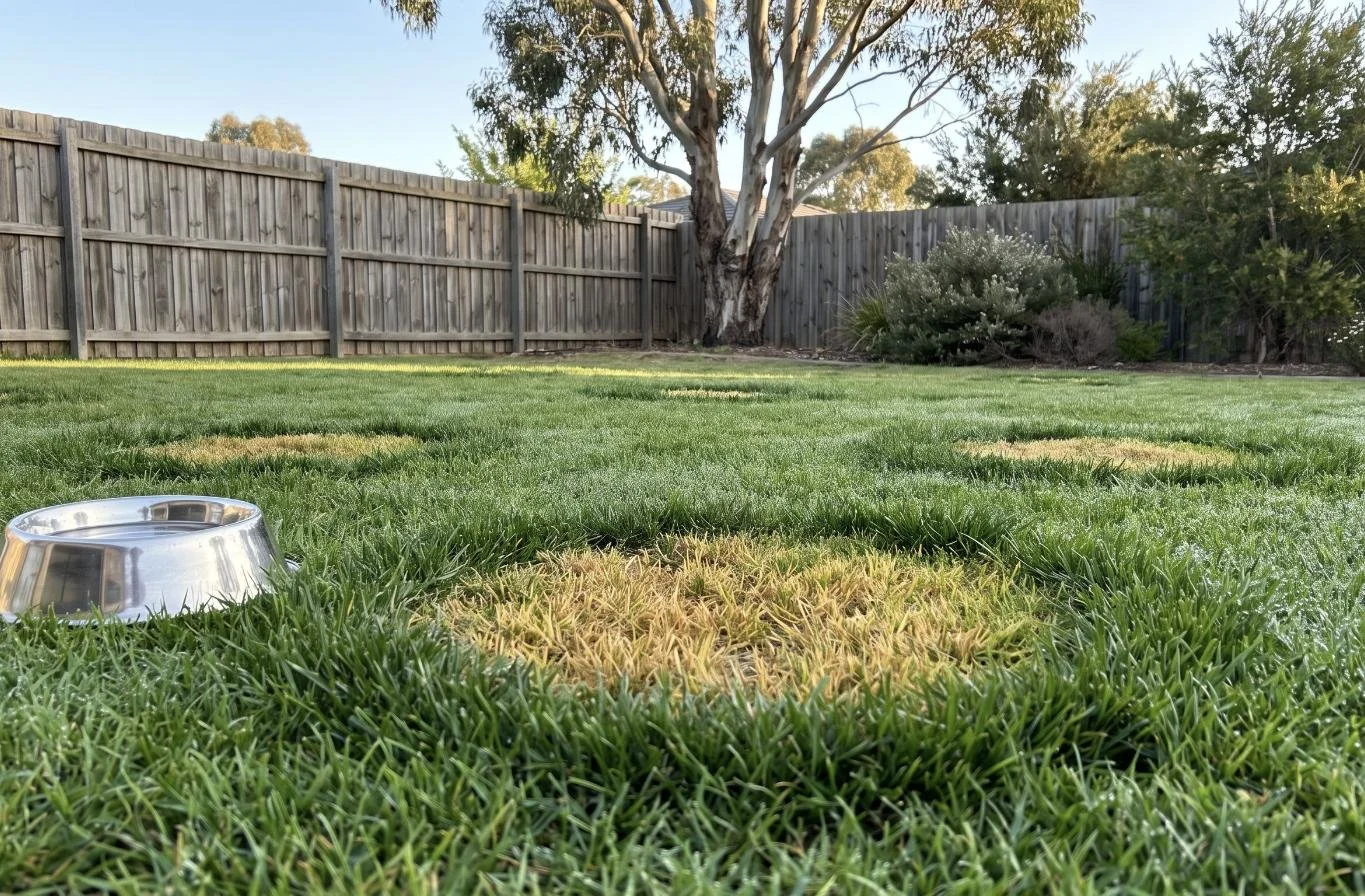
Dog urine makes small round spots, often with a ring of darker, lusher green around a dead centre. They are scattered, they repeat in the same favourite corners, and they turn up one at a time. It is the same salt mechanism, which is why pet urine spots respond to the same heavy watering.
Fungal disease makes rings, arcs or diffuse smoky patches with a greasy edge in the early morning, usually with lesions on individual leaf blades. Disease keeps spreading outward over days, while fertiliser burn appears and then stops appearing.
Pest damage, mostly lawn grubs and beetle larvae here, gives you patches that feel spongy underfoot and peel back like a rug because the roots have been chewed off. If the grass lifts with no root attached, it is a pest problem.
So the test is to stand back and ask whether the pattern is geometric. Geometric means machine, and machine means fertiliser.
Why it happens
Fertiliser is salt. Every bag has what the industry calls a salt index, and the higher it is, the more aggressively that product pulls moisture out of whatever it is touching. When granules sit against a leaf blade or dissolve into soil that is already short of water, the osmotic pull reverses and moisture moves out of the plant instead of into it. That is the burn, and it is dehydration at the cellular level.
The usual causes I find on Canberra lawns:
Too high a rate for the lawn and the season, easily the most common one
Spreader overlap, where two passes double the rate on one strip
An uncalibrated or worn spreader dropping more than the setting suggests
Granules left on a wet leaf after dew, rain or irrigation
Fertilising immediately before a run of hot, dry, windy days
Not watering in, so the product sits in the top few millimetres undiluted
A spill, a dropped scoop or a hopper emptied in one spot while turning
Soluble products used in the heat where a slow release would have been safer
Canberra makes it harder. Our summers are hot and dry, our soils are often clay heavy with thin topsoil, and plenty of lawns sit on fill. A rate that is fine on deep, moist loam in a mild week can scorch on a thin, dry profile in a 35 degree spell, which is why a soil test changes how I feed a lawn.
The first 48 hours
Once the burn is visible, the salts are in the system and the only thing that moves them is water. What I do, in order:
Water deeply straight away, not a light sprinkle. You want water moving below the root zone so the salts travel with it, usually fifteen to twenty-five minutes per zone, and longer on clay, where you may need to water, pause, then water again to avoid run off.
Repeat daily for three to five days. One big soak is not enough, because flushing is cumulative.
Scoop up or hose away undissolved granules on the surface before you soak.
For a bad spill, remove the top centimetre or two of soil and granules, then flush. Dilution alone will not save it.
Stop all other inputs. No more fertiliser, no wetting agents, no weed sprays until it has recovered.
Mow a little higher than usual with sharp blades, so longer leaf shades the crown.
Keep traffic off it. A stressed crown does not need kids, dogs or a trailer on it.
Photograph it with dates, so you can tell recovery from further decline.
Do not reach for a recovery product you saw online, and do not apply a second feed to green it up. More salt on a lawn already struggling for moisture is how a recoverable burn becomes a dead patch.
The recovery timeline, by severity
Light burn, where the leaf tips are yellowed and the crown is clearly alive, greens up within two to three weeks in the growing season, and often needs nothing beyond flushing and sensible mowing.
Moderate burn, where whole blades have gone straw coloured but the crown and lower stem are still firm, takes four to six weeks of active growth. Cool season lawns such as fescue and ryegrass do that work in spring and autumn. Couch and kikuyu recover fastest through the warmer months, and if they are hit late they may sit there looking dreadful until spring.
Severe burn kills the crown, and this is where the false hope lives. If the growing point at the base of the plant has been desiccated, no amount of watering brings it back. It is not dormant, it is dead. Warm season lawns get a second chance, because couch and kikuyu spread by runners and often creep back in from the healthy edges. Cool season lawns have no runners, so a dead patch stays a dead patch until you put seed or turf into it.
The test is a tug and a look. Grip a small tuft and pull gently. If it holds and the base is firm and pale, you have a living crown. If it lifts away dry and brittle, it is gone. Check several spots in each patch, because severity varies even across a small area.
Repairing the bare patches
Once the dead areas have declared themselves, usually three to four weeks after the burn, you can repair rather than guess. For cool season lawns, seeding is the practical answer. Rake out the dead material down to soil, scratch the surface so seed can make contact, sow a matched blend, cover lightly and keep the surface damp through germination. The windows in Canberra are narrow, so my guide to seeding and overseeding covers when it is worth waiting for the right season.
For warm season lawns, you can let the runners fill in, or cut in turf or plugs from elsewhere on the property if you want it closed faster. Either way the repaired area needs soil that holds moisture, which often means dealing with compaction first.
How to prevent it next time
Most of the burn I see is not carelessness. It is a small error in rate or timing that the weather then amplified. What makes the difference:
Calibrate the spreader. Catch what comes out over a measured area, weigh it, adjust. Settings printed on a hopper are a starting point, not a truth.
Spread at half rate in two passes at right angles instead of one heavy pass. It evens out coverage and halves the cost of an error.
Avoid doubling back over the same strip, because overlap causes most stripes.
Apply to dry leaf, so granules land at the soil surface, not on a blade.
Water in properly the same day. In Canberra that is not optional.
Watch the forecast. Never fertilise ahead of a hot, dry, windy run, or feed a lawn that is already moisture stressed.
Favour slow release or coated products through the warmer months. Soluble, fast acting fertilisers give a quick colour response and carry a much higher burn risk when conditions turn. Both have their place, depending on the lawn and the season.
Feed to a plan rather than a hunch. My complete guide to lawn fertilisation in Canberra covers timing through the year.
You will notice I have given you no rates and no product names. That is deliberate, because the right rate depends on your grass type, your soil, the season and what has already gone on this year.
Final word
Fertiliser burn looks catastrophic and usually is not. On most of the lawns I am called to, the stripes are ugly, the crown is alive, and a few heavy soaks plus patience gets it back. The part worth being honest about is the other outcome, where the crown has gone and watering cannot undo it. Knowing that early saves you four weeks of hoping.
What I would avoid is guessing twice. The first guess caused the burn, and the second, usually another product applied to fix the first, turns a recoverable lawn into a renovation. Flush it, leave it alone, assess the crown, then repair what is genuinely dead. A steady maintenance programme built around your soil and your grass type is the simplest insurance against a repeat.
Key points I get asked on a regular basis
How soon after fertilising does burn show up?
Usually two to seven days, and as fast as twenty-four hours if the weather is hot and the product was soluble. Damage that appears a month later is almost certainly something else, most often disease, pests or moisture stress, so note the date you fertilised.
Will watering always fix fertiliser burn?
Watering fixes the cause, which is excess salt in the root zone, but it cannot repair dead tissue. Heavy, repeated watering stops the burn progressing and gives a living crown the moisture to push new leaf. Where the crown has been killed outright, no amount of water regrows it and the patch needs seed or turf.
How can I tell if the crown is dead or just dormant?
Part the grass at the base and pull gently on a small tuft. A living crown feels firm, looks pale green or white at the base and resists the pull. A dead one is dry and brittle and lifts away with no resistance. Check several points per patch, and if you are unsure, give it three weeks of good growing conditions and look again.
Can I just fertilise over the top to green it up again?
Please do not. The lawn is already carrying more salt than it can handle, and another dose makes the moisture deficit worse at the worst moment. Hold off until the lawn has visibly recovered and has been growing normally for a few weeks, then resume on a sensible schedule rather than trying to catch up.
Does fertiliser burn damage the soil long term?
Generally no, as long as it is flushed, because the salts move down through the profile with water. The exceptions are heavy spills, where removing the affected soil is the better move, and lawns with poor drainage or water repellent soil, where salts linger because water will not move through. There, the drainage is the real issue to fix.
How do I book a lawn assessment in Canberra?
Easiest way is to request a free assessment. I will come out, look at the damage, check the pattern and the crown, test the soil where it is warranted, and tell you plainly what happened and what the repair involves. No obligation, just a straight read on your lawn.
Looking for the perfect gift for the lawn enthusiast in your life? The Lawn Firm Gift Cards are the ideal solution. Redeemable for any of our professional lawn care services, these gift cards make it easy to give the gift of a greener, healthier lawn. From fertilisation to weed control and pest management, there’s something for every lawn need.
Why Choose a Lawn Firm Gift Card?
Versatility: Can be used for any service offered by The Lawn Firm.
Thoughtful Giving: A practical gift for anyone who values a beautiful outdoor space.
Simple to Use: Purchase online and enjoy easy redemption.
Order your gift card today and let your loved ones experience the professional touch of The Lawn Firm. It’s the perfect way to show you care while helping someone achieve the lawn of their dreams.
This gift card never expires.