
Lawn Aerator Hire in Canberra: Should You Rent a Machine or Book Coring?
G'day, Nikolai here from The Lawn Firm. Every spring I get the same phone call. Someone has looked at their tired, compacted lawn, done a bit of reading, worked out that aeration is the answer, and then hit the real question: do I hire a machine for the weekend, or do I get someone in to do it.
It is a fair question and I am not going to pretend the answer is always "call me". Plenty of Canberra lawns are hired-machine jobs. Plenty are not. The difference usually comes down to your soil, your lawn size, and whether you are prepared to do the work that comes after the aerating, because that is where most of the benefit actually lives.
So here is how I would decide if it were my backyard.
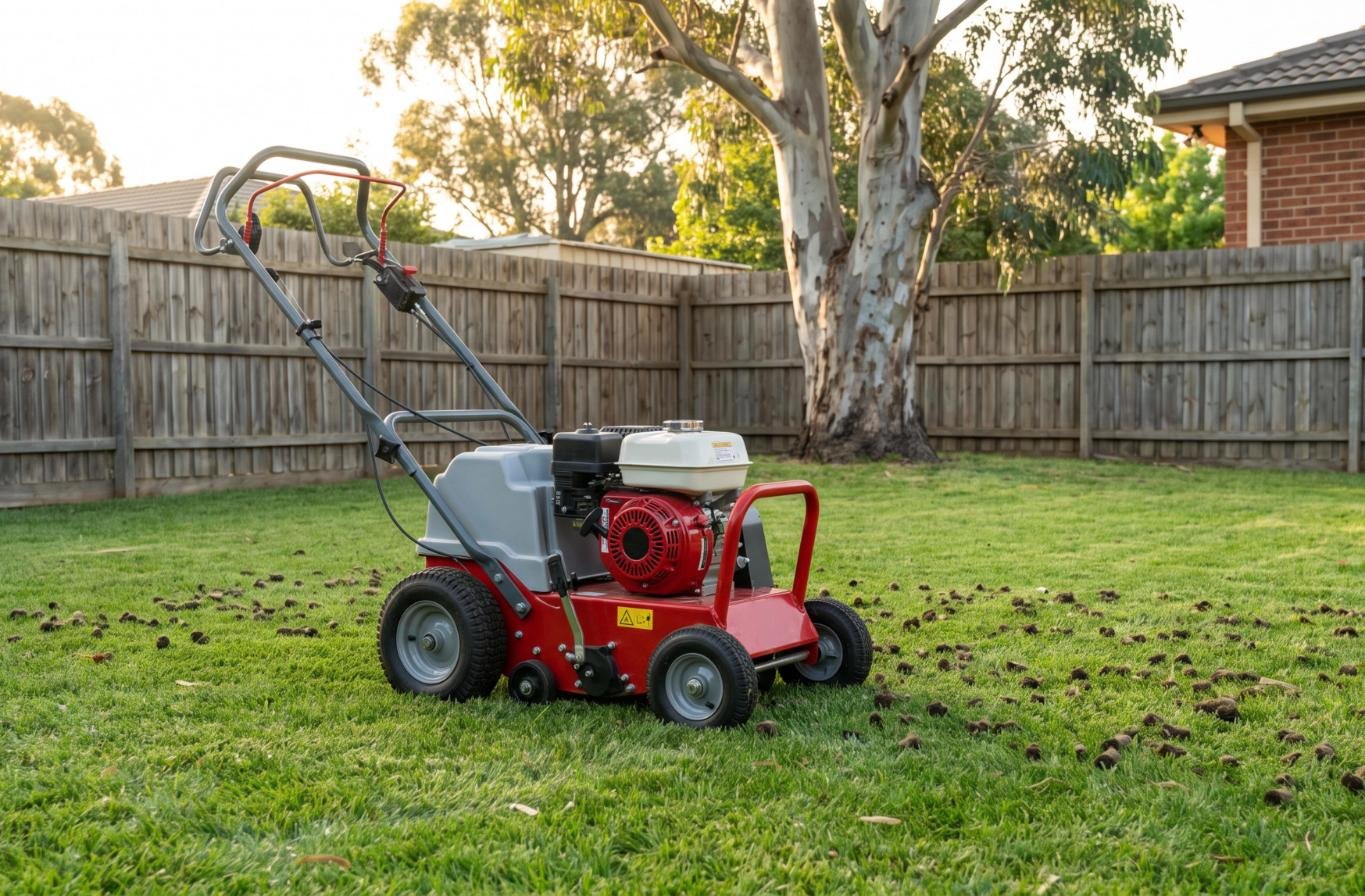
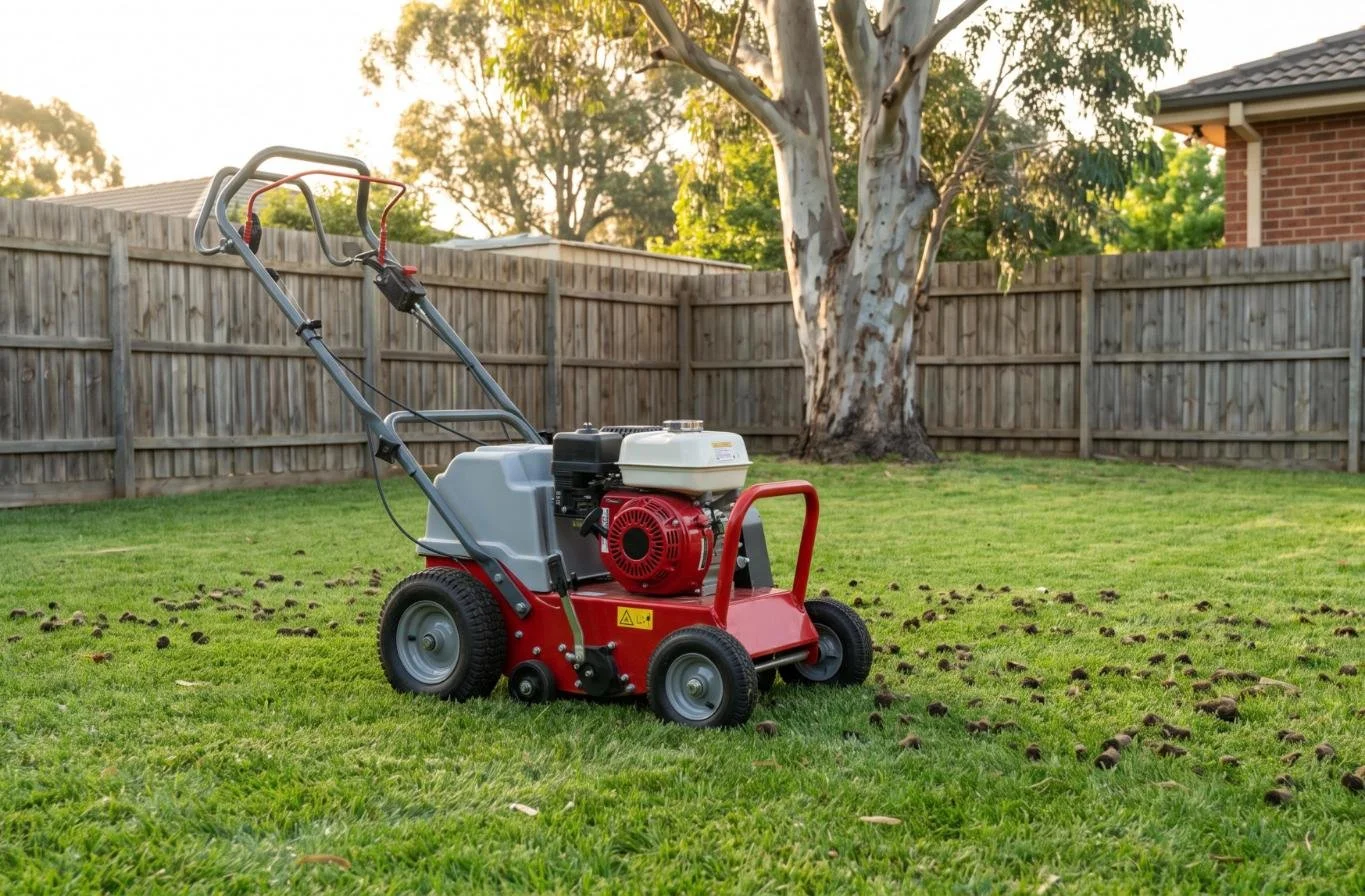
A walk behind core aeration machine on a green Canberra backyard lawn with soil cores scattered across the surface
The quick answer: hire or book?
Hire a machine yourself if your lawn is under roughly 300 square metres, the soil is workable rather than rock hard, you have a way to tow or transport the machine, and you already have a plan for the fertiliser, seed or sand that goes down afterwards.
Book a professional coring service if the ground is genuinely compacted heavy clay, the lawn is large or awkward to access, you cannot lift 80 to 100 kilograms, or you want the aeration to be part of a wider fix rather than a standalone weekend job.
Hire cost: commonly around $80 to $160 for a half day or day rate on a walk behind corer, plus transport. Confirm current rates directly with the hire company, as they change.
Professional coring: priced per lawn, and usually includes the follow up work, machine transport, and someone who has already worked out where your irrigation lines run.
The honest middle ground: if you are physically able and your lawn is small and flat, hiring is good value. As soon as clay, slope, size or your own time enters the picture, that value drops away quickly.
The one thing I would say firmly is this. Aerating and then doing nothing else is close to a wasted day. The holes close up in a few weeks. What makes aeration worth doing is what you put into those holes while they are open.
Core aerator, spiker, sandals: they are not the same thing
This trips up more people than anything else, because hire shops list several products under similar names.
A core aerator, sometimes called a corer or a plug aerator, pulls out plugs of soil roughly 50 to 75 millimetres deep and leaves them on the surface. It physically removes soil, which relieves compaction. This is the machine that does real work.
A spiker or slitter pushes solid tines into the ground. It makes holes without removing anything, which means the soil beside each hole gets pushed sideways and compressed. On Canberra clay this can actually make compaction slightly worse around the hole wall. Spiking has its place on sandy soils and for quick water penetration, but it is not a substitute for coring.
Aerating sandals, the spiked shoes you strap over your boots, are not a serious tool for a compacted lawn. They are solid tines again, they are shallow, and you cannot cover ground evenly. I would not spend money on them.
If you are hiring, make sure you are hiring a core aerator, not a spiker. The price is similar and the outcome is not. My complete guide to lawn aeration for Canberra lawns goes deeper on what is actually happening in the root zone if you want the full picture.
What you can hire, and what it is like to use
Most Canberra hire yards carry a petrol walk behind core aerator. They are heavy, typically 80 to 130 kilograms, and they are not self propelled in the way a mower is. You are steering and wrestling a vibrating machine, not strolling behind it.
A few practical realities that people do not expect:
You will need a trailer or a ute. These machines do not go in a hatchback, and most hire yards will not deliver a single item to a residential address for free.
Loading is the hard part. Getting the machine up a ramp is where people hurt themselves. Two people is not optional.
Access matters. If your only way into the backyard is a 700 millimetre side gate with a step, measure before you book.
It is slower than you think. For a 200 square metre lawn, allow two to three hours by the time you have collected the machine, done two passes, and returned it.
Hire periods are short. A four hour window sounds generous until you factor in travel and a fuel stop.
None of that is a reason not to do it. It is a reason to be realistic about what a Saturday looks like.
Where Canberra clay changes the maths
This is the part that is genuinely local, and it is the reason I sometimes tell people not to bother hiring.
A lot of Canberra suburbs sit on heavy clay subsoil, particularly in the newer estates in Gungahlin and Molonglo where topsoil depth over the building pad can be thin. When that clay is dry, it sets like concrete. A hired corer running over bone dry Canberra clay in February will bounce, scratch the surface, and pull tiny broken plugs about 20 millimetres long. You will have spent your money and your Saturday and achieved very little.
The fix is water, and it is non negotiable. The lawn needs to be moist right through the top 100 millimetres before you aerate. In practice that means watering deeply for two or three days beforehand, or aerating a day or two after solid rain. Not soaking wet, because then the tines smear and the plugs turn to mud, but properly damp.
If you have tried to push a screwdriver into your lawn and it stops dead at 30 millimetres, that is your soil telling you something. It may be compaction, it may be that the surface is repelling water altogether, which is a different problem. My guide to hydrophobic soil and dry patch covers how to tell the two apart, and if water is sitting on the surface for hours after rain, clay soil drainage is the more likely culprit.
There is a second clay problem. On the heaviest ground, one pass of coring in one spring is not going to transform anything. Improving genuinely compacted clay is a two or three year programme of coring plus sand or organic matter worked into the holes. That is a maintenance programme, not a weekend hire.
Timing: get this wrong and the machine does not matter
Aeration opens the lawn up and stresses it briefly. You want the grass actively growing so it recovers quickly and fills the holes with new roots.
For warm season grasses, which is most Canberra backyards running couch, kikuyu, buffalo or zoysia, the window is October through to early February, once the soil has genuinely warmed and the lawn is in strong growth. September is usually a fortnight or two too early here, because our soil lags the air temperature.
For cool season grasses, mainly tall fescue, the window is early to mid autumn, March into April, with early spring a workable second option.
Do not aerate in winter. The lawn is not growing, the holes stay open, and you have created a lot of open soil at exactly the time winter grass and bindii are germinating.
That last point is worth sitting with. Aeration creates hundreds of perfect seed beds. If you have a weed seed bank in that lawn, you are giving it an invitation. This is why I would usually want a pre emergent applied on the right timing as part of the year's plan, and why aerating into a weedy lawn without a weed strategy tends to backfire.
What goes in the holes is the whole point
If you hire a machine and do only one more thing, do this: feed the lawn immediately afterwards.
Here is the sequence I would follow on a domestic lawn, and it is the same whether you or I am running the machine.
Water deeply two to three days before. Moist to 100 millimetres.
Mark your irrigation heads, cables and shallow pipes. A corer will find them for you otherwise, expensively.
Make two passes at right angles. One pass leaves gaps. Two passes in a cross hatch gives you an even hole pattern.
Leave the plugs on the surface. They break down in a week or two and return soil and microbes to the lawn. Raking them up is extra work for a worse result. If you cannot stand the look, run over them once the lawn dries.
Fertilise straight away, while the holes are open. Nutrient going into the root zone rather than sitting on the surface is most of the value. My fertilisation guide covers what to use and when.
Then, if the lawn is thin, overseed or top dress. Aeration day is the single best day of the year to overseed or to top dress, because you have thousands of open channels for seed and sand to fall into.
Keep the water up for three weeks. The lawn is recovering and any new seed is establishing.
If the lawn also has a spongy, springy feel underfoot, aeration alone will not fix it. That is thatch, and it needs dethatching or scarifying rather than, or as well as, coring. Doing both in one season is hard on a lawn, so the order matters.
When I would tell you to just hire the machine
I am happy to say it plainly. Hire the machine if:
The lawn is small, flat and accessible.
The soil is reasonable loam rather than set clay, and a screwdriver goes in easily when the lawn is damp.
You enjoy this sort of thing and have a free Saturday.
You have already bought the fertiliser and the seed, and you know what you are doing with them.
The lawn is basically healthy and you are maintaining it, not rescuing it.
That is a real and common situation, and paying someone would be paying for convenience rather than outcome.
When I would book coring instead
I would book it out if:
The ground is heavy clay and genuinely hard, which is where a domestic hire machine underperforms most.
The lawn is over about 300 square metres, where the hire day stops being a saving.
Access is tight, sloped, or the machine has to cross pavers.
You have irrigation and do not know exactly where it runs.
The lawn has more than one problem. If it is compacted and thin and weedy, aerating is one step in a sequence, and sequencing it wrongly wastes the effort.
You want it to actually change something over two or three seasons, which is what a year round maintenance programme is for.
If you are weighing this up more broadly across all your lawn jobs, not just aeration, I have written about DIY versus professional lawn care in Canberra as well.
Not sure which side of the line you are on? That is exactly what an assessment is for. Book a Free Assessment and I will tell you honestly whether this is a hire job or not.
Final word
Aerator hire is good value for the right lawn and a poor use of a weekend for the wrong one. The machine is not really the variable. Your soil is.
Test it yourself before you book anything. Water the lawn well, wait a day, then push a long screwdriver into the ground in three or four places. If it slides in 100 millimetres without much effort, your lawn is not badly compacted and a hire machine will do a tidy job. If it fights you at 40 millimetres, you have the kind of ground where a one off pass will not achieve much on its own, and you are better off treating it as a multi season fix.
Either way, do not aerate and walk away. Feed it, seed it if it is thin, and keep the water up. That is where the lawn you actually want comes from.
If you would rather not guess, Book a Free Assessment and I will check the soil, the thatch layer and the grass type before anyone starts a machine.
Key points I get asked on a regular basis
How much does lawn aerator hire cost in Canberra?
Walk behind core aerators commonly hire for somewhere around $80 to $160 for a half day or day rate, depending on the yard and the machine. Treat that as indicative rather than a quote, because hire rates change and vary between suppliers. Add fuel, a bond, and the cost of getting a machine that weighs over 80 kilograms to your house and back. Once you have added those up, the gap between hiring and booking a service on a small lawn is often smaller than people expect.
Is a core aerator better than a spike aerator?
For relieving compaction, yes. A core aerator removes plugs of soil, which creates genuine space for air, water and roots. A spiker pushes solid tines in and compresses the soil around the hole, which on Canberra clay can be counterproductive. If you are paying to hire something, hire a corer. Spiking is fine for quick water penetration on light soils but it is not the same job.
When is the best time to aerate a lawn in Canberra?
Aerate when the grass is actively growing so it can recover. For warm season lawns such as couch, kikuyu, buffalo and zoysia that means October through to early February, once the soil is properly warm. For cool season lawns such as tall fescue, early to mid autumn is the best window. Avoid winter altogether, because the lawn is not growing and you are opening the soil up right when winter grass and bindii germinate.
Should I pick up the soil plugs after aerating?
No, leave them. They break down within a week or two and return soil, organic matter and microbes to the surface, which is part of the benefit. Raking them off is a lot of work for a worse outcome. If the look bothers you, wait until they dry out and then run over the lawn once to break them up.
How often does a Canberra lawn need aerating?
Most domestic lawns here benefit from coring once a year. Lawns on heavy clay, or ones that get a lot of foot traffic from kids, pets or a trampoline, can justify twice a year during the growing season. Lawns on lighter, free draining soil with little traffic may only need it every second year. The screwdriver test is a better guide than the calendar.
How do I book lawn aeration in Canberra?
The easiest way is to Book a Free Assessment. I will come out, test the soil and the thatch layer, work out whether coring is the right next step for your lawn or whether something else needs doing first, and give you a straight answer about whether this is a job worth hiring a machine for yourself. No obligation either way.

Looking for the perfect gift for the lawn enthusiast in your life? The Lawn Firm Gift Cards are the ideal solution. Redeemable for any of our professional lawn care services, these gift cards make it easy to give the gift of a greener, healthier lawn. From fertilisation to weed control and pest management, there’s something for every lawn need.
Why Choose a Lawn Firm Gift Card?
Versatility: Can be used for any service offered by The Lawn Firm.
Thoughtful Giving: A practical gift for anyone who values a beautiful outdoor space.
Simple to Use: Purchase online and enjoy easy redemption.
Order your gift card today and let your loved ones experience the professional touch of The Lawn Firm. It’s the perfect way to show you care while helping someone achieve the lawn of their dreams.
This gift card never expires.